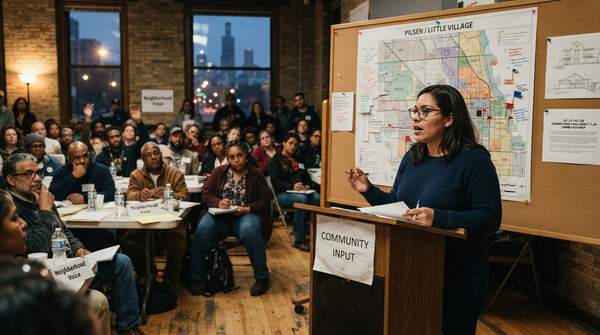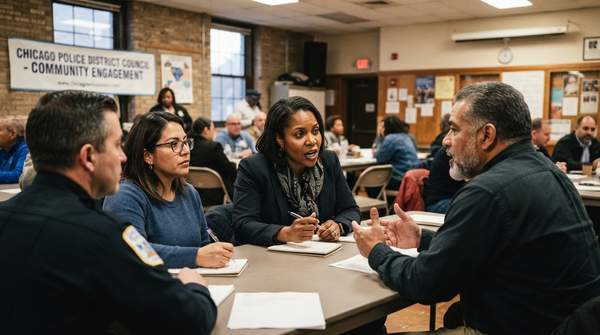
Chicago residents who want a say in how their neighborhood is policed have an official, elected entry point: their Police District Council. Each of the city's 22 police districts has one, made up of three councilors elected to four-year terms, and their core job is to hold monthly public meetings where residents raise concerns, set local priorities, and work on community safety initiatives. The councils are advisory rather than policy-making — the bigger decisions rest with the citywide Community Commission for Public Safety and Accountability (CCPSA), which the councils feed into. Here is how the system works and how to plug into it.
Understanding Chicago's Police Oversight Structure
The structure comes from an ordinance Chicago's City Council passed in July 2021, often called the Empower Communities for Public Safety ordinance. As the CCPSA's own description of the law explains, it created two bodies at once: a citywide Community Commission for Public Safety and Accountability, with power to advance systemic reform, and District Councils elected in each police district to work on policing and public safety at the local level.
The two tiers are deliberately linked. The district councils are the local layer — one per police district, each its own separate public body — while the commission operates across the whole department. Civic newsroom City Bureau, which has covered council meetings through its Documenters program, describes the district councils' position plainly: they discuss policing issues specific to their district, inform the community about what the citywide commission does, gather input from neighbors about public safety, and develop community policing initiatives. In other words, resident input enters the system locally and flows upward.
The first elections for district councilors took place in 2023, on the same municipal ballot where Chicagoans vote for mayor and alderpersons. Councilors serve four-year terms and, per the CCPSA, are accountable to the residents of their police district.
The Role and Powers of Police District Councils
According to the CCPSA, district councils have several key roles. They hold monthly public meetings where residents can work on local initiatives rooted in community concerns and priorities, raise and work to address concerns about policing in the district, and increase accountability. They also build stronger connections between police and the community at the district level, where the community is meant to be a true partner in making the neighborhood safer — working with police to address problems and set priorities. Finally, they collaborate in developing and implementing community policing activities.
What that looks like in practice varies by district. City Bureau's reporting points to meetings that have tackled issues such as migrants sheltering inside police stations, opened discussions about public safety goals, and even produced a no-confidence vote in a high-ranking police official — evidence that the councils can be a genuine public forum, even without formal authority over personnel.
The limits matter just as much. District councils do not set department policy, and they cannot hire or fire police officials. Their influence on citywide decisions is indirect: they gather local input and pass it along, serving as the connective tissue between neighborhoods and the more powerful commission.
Chicago's Two-Tiered Police Oversight System Explained
The table below maps how authority and information flow through the system, so you can see exactly where local input connects to citywide policy.
| Body | Level of operation | Key powers and roles | Relationship to residents |
|---|---|---|---|
| Police District Councils (22 total) | Local — one per police district | Hold monthly public meetings; develop local initiatives; raise and address district policing concerns; gather community input; inform residents about the CCPSA; collaborate on community policing | Primary local entry point — residents elect the three councilors and participate in their meetings |
| Community Commission for Public Safety and Accountability (CCPSA) | Citywide — oversees the entire Chicago Police Department | Hire or fire public safety officials; oversee department-wide policy; review CPD's budget and recommend changes; draft police policies open to public comment | Receives input channeled upward through District Councils; residents can also submit written public comment to the Commission |
Reading the table as a flow: residents engage at the district level, where councils collect concerns and priorities; those councils relay community input and inform residents about the commission's work; and the commission acts on department-wide policy and leadership. The direction of authority runs the other way — the commission holds the formal power, while the councils' role is advisory.
District Councils vs. Community Commission: A Clear Distinction
The contrast in power is sharp. City Bureau summarizes it this way: the citywide commission can hire or fire public safety officials and oversees policy issues affecting the entire department — citing recent discussions around CPD's use of traffic stops — while the district councils stay focused on issues specific to their own district.
The commission's authority is real but bounded. Writing before the 2023 elections, Kareem Butler of the Chicago Appleseed Center for Fair Courts noted that while the CCPSA is authorized to draft and vote on police policies open to public comment, the Mayor can veto policies the Commission agrees on, and overriding that veto requires a two-thirds majority vote in City Council. The Commission can dismiss the COPA Chief Administrator for cause, with City Council approval. On money, its reach is limited to reviewing CPD's budget and recommending changes — "that is where their budgetary influence ends," in Butler's phrasing.
Butler's assessment of the design is worth noting: the dilution of independent decision-making power is a consistent theme in the ordinance, and the district councils, while important to constructing the more influential commission, reflect the city's reluctance to let residents directly exert influence over policing. For residents, the practical takeaway is that district councils are where your voice enters the system, not where final decisions are made.
How Chicago Residents Can Participate in Their District Council
Participation starts with identifying your police district — the CCPSA's website offers a "Find my District" tool for exactly this purpose. Once you know your district, you know which council represents you. The CCPSA also maintains information for residents interested in serving on a council, and council seats come up for election in Chicago's municipal elections, the same ballots used for mayor and alderpersons.
From there, the steps are straightforward:
- Find your district using the CCPSA's lookup tool, which also shows the trends and concerns impacting your district.
- Attend your council's monthly public meetings. The CCPSA describes these meetings as the place where residents work on local initiatives rooted in community concerns and priorities.
- Bring your concerns. Meetings are the venue for raising and working to address policing concerns in the district and for setting priorities alongside police.
- Submit written public comment. Anyone may submit one, either by delivering it to a public meeting or by emailing CommunityCommissionPublicComment@cityofchicago.org — a channel that reaches the citywide Commission as well as the district bodies.
- Consider running or voting. Councilors are elected to four-year terms in municipal elections, so the ballot is another route to shape your council.
One caveat: the evidence supports that meetings are monthly and public, but schedules vary by district, so check your council's announcements for the specific time and location rather than assuming a fixed citywide calendar.
Engaging with Your Police District Council
Chicago residents can actively influence local policing by attending monthly District Council meetings, providing public comment, and collaborating on community safety initiatives. That is the realistic scope of the opportunity: councils are advisory bodies that channel neighborhood input into a system whose formal power sits with the citywide commission, where the Mayor can still veto policy.
The measurable indicator of your engagement is regular attendance and participation in District Council meetings, and submission of public comments, as indicated by published meeting minutes or council reports. If you attend your council's next monthly meeting and submit a written comment — in person or by email — you can verify your participation showed up in the record the council keeps.