Chicago neighborhood planning runs through several distinct channels, and the single most important thing a resident can do is figure out which one applies to the project on their block. A citywide framework like We Will Chicago is led by the Department of Planning and Development; public housing redevelopment is run by the Chicago Housing Authority; and local zoning and development decisions typically flow through your alderman's office, sometimes with a formal resident-led process attached. Each pathway has its own decision-makers and its own moment where public input carries weight. This guide maps those pathways to the people in charge and the concrete steps that make participation effective.
Navigating Chicago's Neighborhood Planning Landscape
There is no single "planning office" in Chicago that handles everything. Instead, the city's planning landscape is a patchwork of agencies, officials, and community bodies, each with its own scope. The Department of Planning and Development (DPD) leads citywide planning: We Will Chicago, a 10-year framework for citywide growth, was approved by the Chicago Plan Commission after three years of intensive neighborhood-based and virtual public engagement, and it contains more than 40 goals and 150 objectives across eight "planning pillars" intended to guide budgets, capital projects, and policy priorities.
The Chicago Housing Authority (CHA) runs its own community-driven planning and design processes for public housing sites, holding community stakeholder meetings with CHA resident leadership groups, other community groups, and city departments at each phase. Local zoning and development decisions—the ones that most often change a block's character—run through the alderman's office, where practices vary widely by ward. In some wards, residents have negotiated formal processes of their own: the 35th Ward's Community-Driven Zoning & Development (CDZD) process emerged after residents facing displacement wanted an inclusive, transparent process that would put affordability concerns front and center, rather than decisions made without them.
The practical consequence is that the same resident, on the same street, might need three different strategies depending on whether the issue is a citywide policy, a CHA redevelopment, or a zoning change. The framework below sorts those scenarios so you can find your entry point quickly.
Chicago Neighborhood Planning: A Resident's Decision Framework
Use this table to classify the initiative in your neighborhood, identify who leads it, and find your first step. The classification works by scope and lead entity: a citywide framework touches budgets and policy across all of Chicago; a public housing development sits on CHA property; a local zoning change affects a specific parcel or corridor; and a community-led placemaking effort is typically initiated by residents themselves.
| Type of Initiative | Lead Agency / Key Player | Primary Engagement Point for Residents | Qualification |
|---|---|---|---|
| Citywide planning framework (e.g., We Will Chicago) | Department of Planning and Development; approved by the Chicago Plan Commission | Public meetings, virtual sessions, and in-person and online surveys | DPD collected feedback from more than 10,000 individuals during We Will Chicago engagement |
| Public housing development (e.g., Cabrini NOW) | Chicago Housing Authority | Community stakeholder meetings at each planning phase, with CHA resident leadership groups and city agencies | CHA describes a three-phase process—listen, suggest, improve—where community feedback shapes planning and design concepts |
| Local zoning and development change | Local alderman's office; in some wards, a resident-led process such as the 35th Ward's CDZD | Contact your alderman's office and attend community meetings on the specific project | Aldermanic offices can provide contacts for local decision-makers and information on applicable statutes; practices vary by ward |
| Community-led placemaking (e.g., Senn Park Unity Garden) | Resident groups and neighborhood associations, often with aldermanic support and city agencies such as the Chicago Park District | Community workshops and meetings organized by a local group | Local-group coordination with aldermanic support draws greater participation than government-organized events at City Hall |
The reasoning behind the mapping is straightforward: each initiative type concentrates authority in a different place, so the effective participation point differs too. Citywide plans reward broad, distributed feedback; CHA projects reward sustained presence at stakeholder meetings; zoning changes reward direct engagement with the alderman, whose support a project typically needs; and placemaking rewards residents who organize first and bring officials in as partners.
Strategies for Effective Community Participation
Identifying the right meeting is only the start. The evidence from Chicago's own successful engagement efforts points to tactics that consistently make resident input count.
Organize before you show up. A placemaking guide drawing on Chicago examples notes that it is usually most effective for a local group—a nonprofit or neighborhood association—to coordinate the logistics of a community workshop, with support from the alderman. That organizing strategy, the guide explains, ensures community participation in greater numbers than if the event is organized by local government in the formal setting of City Hall—while including local officials in the process remains paramount to a project's success. The Senn Park Unity Garden illustrates the payoff: over one winter of community meetings convened with the Chicago Park District, students, neighbors, families, seniors, and block clubs agreed on a design, and by spring residents had a plan in hand.
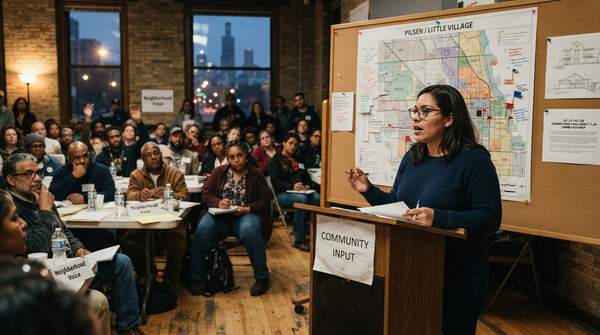
Push for a transparent process, not just a meeting. In the 35th Ward, residents facing displacement wanted more than access to decisions—they wanted a system that would let them win concessions from developers before a project received a green light from the local alderman. The resulting CDZD process moved decisions out of closed-door settings and into public forums where residents felt welcomed and encouraged to participate, producing well-attended meetings where residents advocate for and win equitable development outcomes, as reported by New America's account of the effort.
Demand accessible, complete information. The same account stresses that residents need accurate and comprehensive information to make planning decisions, and that inclusivity must be demonstrated through services like language accessibility, universal accessibility, and child care at meetings so people can fully engage. Because every zoning change has its own nuanced particulars, a standardized process for deciding on these changes helps ensure communities are centered and have buy-in.
Use citywide plans to back your position. We Will Chicago's stated purpose is to guide annual budgets, capital projects, and policy priorities so public decision-making focuses on the needs of the entire city and all its residents. Citing its goals and objectives in a local dispute connects your block-level concern to an adopted citywide framework.
Key City Departments and Community Resources
A short directory of the bodies most likely to appear in any Chicago planning process:
- Department of Planning and Development (DPD): Leads citywide planning initiatives, including We Will Chicago, and collected feedback from more than 10,000 individuals through in-person and online surveys, street festivals, and virtual and in-person information meetings.
- Chicago Plan Commission: The body that approved We Will Chicago after its three-year public engagement process.
- Chicago Housing Authority (CHA): Leads community-driven planning and design for public housing sites, engaging resident leadership groups and city agencies at each phase; its Cabrini NOW effort is a current example of planning for new housing and economic development on a CHA property.
- Your alderman's office: The key player for local zoning and development decisions; it can provide contacts for local decision-makers and information on statutes.
- Metropolitan Planning Council: Partnered with the Chicago Council on Global Affairs to host the Global Voices, Local Action webinar series as part of We Will Chicago engagement, featuring local and international leaders discussing the plan's pillars.
- Neighborhood associations and block clubs: The organizing backbone for placemaking and zoning advocacy, from the Unity Garden model to ward-level zoning processes.
Your Voice Shapes Chicago's Future
Chicago's planning systems are not a single door but several, and each opens at a predictable point: surveys and public meetings for citywide frameworks, stakeholder meetings for CHA developments, aldermanic engagement for zoning changes, and resident-organized workshops for placemaking. The consistent lesson across these pathways is that participation works best when residents organize together, arrive with specific goals and accurate information, and engage the official who actually holds decision-making power for that initiative type.
Residents should actively identify the type of planning initiative affecting their neighborhood and engage with the appropriate city agency or local official through established participation channels. The measurable indicators of doing this well are concrete: increased attendance and informed participation in public meetings, submission of specific feedback to relevant city departments, or direct engagement with local aldermanic offices regarding neighborhood projects. One caution as you proceed: this guide covers official participation processes, not legal advice for zoning disputes, and specific steps and timelines vary by project, ward, and alderman—so confirm the process for your particular initiative with the lead office before relying on any general model.
Sources
- We Will Chicago
- Community Planning — Chicago Housing Authority
- Placemakingchicago
- Chicago: Centering Residents in Neighborhood Development Decisions — New America