Chicago is launching a two-year mobile lead testing pilot that will bring free childhood lead screening directly to families in six South Side neighborhoods where many children ages 1 to 3 have not been tested. The Chicago Department of Public Health announced the program on October 26, 2026, in partnership with Prism Health and United Way of Metro Chicago. Testing carries no bill, copay or out-of-pocket cost, walk-ins are welcome, and families can also request a free home water test kit from the city's Department of Water Management.
Chicago Launches New Mobile Lead Testing Pilot Program
The pilot, announced by CDPH's public information office, is designed to close a testing gap: a significant number of children ages 1 to 3 in the targeted communities have not been getting tested for lead. Rather than requiring families to travel to a clinic, Prism Health will operate mobile testing units that visit daycares, schools, libraries, places of worship and community organizations across the six communities over the next two years.
WTTW News reported that the announcement coincided with National Lead Poisoning Prevention Week, observed during the last week of October. The program's core premise, according to the health department, is that bringing screening to familiar neighborhood locations removes barriers that have kept testing rates low in these areas.
Targeted South Side Neighborhoods and Program Rationale
The pilot focuses on six neighborhoods: Englewood, West Englewood, South Chicago, Greater Grand Crossing, Auburn Gresham, and New City. CDPH selected these communities because a significant number of children ages 1 through 3 there have not been tested for lead, according to the department's announcement.
Reporting by CBS Chicago adds context for the geographic focus: while all of Chicago draws drinking water from one source, the channels between Lake Michigan and home taps mean some areas face a higher likelihood of lead exposure, and lead exposure disproportionately affects some Chicago communities more than others. The pilot responds to that uneven burden by concentrating mobile screening where untested children are concentrated.
Understanding Childhood Lead Exposure Risks
According to CDPH, lead exposure can harm children's intellectual development, attention, behavior and academic achievement, even at low levels. CBS Chicago's report lists serious potential consequences including learning disabilities, speech problems, and delayed growth.
The department identifies deteriorating lead-based paint and dust, especially in older homes, as a common exposure route, along with contaminated soil, certain imported goods, jewelry, and pottery. Prism Health President Zul Kapadia described how easily young children encounter the hazard: "Their hands touch floors and windowsills before going straight into their mouths. Lead dust can expose a child without them ever knowingly eating anything containing lead." Dr. Mehbub Kapadia, executive officer at Prism Health, emphasized the payoff of catching exposure early, saying that "simple prevention can take a child health to a very, very normal growth, and that is what is needed."
Is Your Child Eligible? Your Lead Testing Checklist
Work through these checks in order. If both eligibility checks are yes, your family is in the pilot's primary target group; the action steps below apply either way for residents of the six neighborhoods.
- Check 1 — Your child's age: The pilot targets children ages 1 to 3. If your child is in that range, continue to Check 2.
- Check 2 — Your neighborhood: Do you live in Englewood, West Englewood, South Chicago, Greater Grand Crossing, Auburn Gresham, or New City? If yes, your family is in the primary target group for mobile testing events.
- Action 1 — Register for a mobile clinic: Find locations and register at Prism.org/lead, or call (800) 325-1812. Walk-ins are welcome and no one is turned away.
- Action 2 — Request a free home water test kit: Request one from the Chicago Department of Water Management, available through the sign-up channels CBS Chicago identified on Prism Health's website.
- Action 3 — Ask a host site to hold a clinic: If you have a church, daycare, or community center that serves kids under 6, program organizers want to hear from you about hosting a testing clinic during the two-year pilot.
- Action 4 — Get lead-hazard information for your home: Parents, expectant mothers and caregivers concerned about lead hazards can call 312-747-LEAD (5323) or visit Chicago.gov/lead.
The cost answer is unambiguous: testing is free for every family, with no bill, copay or out-of-pocket cost. For insured children, Prism Health bills the insurance plan directly, and families will never receive a bill or balance.
What to Expect from the Mobile Testing Program
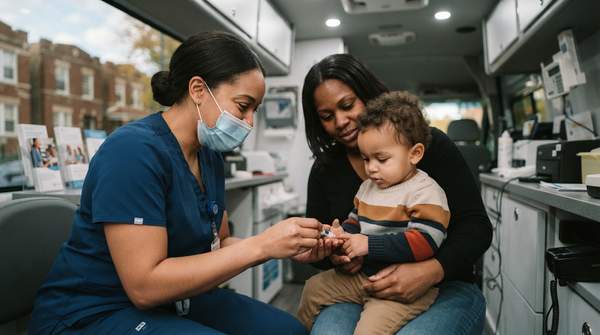
Mobile testing units operated by Prism Health will set up at daycares, schools, libraries, places of worship and community organizations across the six neighborhoods through the two-year pilot. CBS Chicago reports the testing method is a fingertip prick, a quick procedure designed for young children in familiar settings.
A complete schedule of clinic dates and locations has not yet been published in the available announcements, so families should check the registration page or call the number above for events near them. The program does not stop at screening: its stated goal is to enable early detection and connect families to follow-up care and prevention resources. This article does not interpret test results or provide medical guidance for elevated lead levels; families with concerns about a child's results should speak with their health care provider.
Next Steps for Protecting Your Child's Health
Families in the targeted South Side neighborhoods with children aged 1-3 should utilize the free lead testing services provided by the pilot program. The measurable indicator of the pilot's reach will be increased participation in mobile clinics and requests for home water test kits, leading to a rise in the number of children tested for lead in the six targeted communities. Watch for the first mobile clinic dates as the program begins in November 2026, and if you are unsure whether your block is covered, registration staff at (800) 325-1812 can confirm before you go.