Chicago does not set official trick-or-treating hours, and it never has. Unlike many surrounding suburbs, which publish designated times in the days or weeks before Halloween, the city leaves the timing entirely to neighborhoods. Local reporting from Block Club Chicago and NBC Chicago consistently confirms this, which is why parents flood neighborhood Facebook pages every October with the same confused question. The practical answer: on a weekday Halloween, expect the main rush after 5 p.m.; on a weekend, activity can begin in the mid-afternoon — and your best guide is what's happening on your own block.
Chicago's Unofficial Halloween: Understanding Local Norms
The absence of official hours is a long-standing Chicago pattern, not a recent change. Block Club Chicago has reported the same situation in multiple years: "There is no official, citywide start time for trick-or-treating in Chicago," and the city does not release hours, "unlike many suburbs." NBC Chicago's reporting matches: "While most suburbs publish their hours ahead of Oct. 31, the city of Chicago does not have designated trick-or-treat times."
What fills the vacuum is neighborhood custom, which varies block by block. Some areas organize earlier block parties or Halloween-specific events that shift when doorbells start ringing. Some neighborhoods hold weekend events like pumpkin carving in the parks or trick-or-treating along business corridors, though those are auxiliary to the door-to-door main event. The result is a system that frustrates anyone seeking a single authoritative answer — but it also means the answer is discoverable by watching local cues.
The Weekday Halloween: Timing Your Neighborhood Adventure
When Halloween falls on a weekday, the pattern is fairly predictable, and it's anchored to two schedules: school and work. Most Chicago public schools let out in the 3 p.m. hour, so a few enterprising kids may ring doorbells on their way home from school. But the major rush, as Block Club Chicago observed in 2024, comes around 5 p.m., after kids have gone home to grab their plastic pumpkins or pillowcases — and possibly parents — and after candy distributors have had time to get home from work.
That makes after 5 p.m. the safe spot on a weekday. Starting much earlier risks knocking on doors where adults aren't home yet; starting much later misses the peak flow of costumed neighbors. Sunset matters too: once darkness arrives, participation tends to thin, both among trick-or-treaters and households keeping their porch lights on.
The Weekend Halloween: Embracing Earlier Starts
A weekend Halloween scrambles the weekday logic, because the school-and-work constraint disappears. When the holiday fell on a Saturday in 2026, Block Club Chicago reported that the safe spot appeared to be any time after mid-afternoon, with some neighborhoods holding earlier block parties to take full advantage of the day. Not everyone agreed: an informal survey found some parents planned to start even earlier, while others worried participating houses wouldn't be ready for costumed visitors quite yet.
Sunset remains the useful anchor. For the 2026 Saturday Halloween, sunset was predicted for 5:45 p.m., and some families simply wait until dark regardless. A weekend afternoon start also has a built-in advantage for younger kids: a few daylight hours of trick-or-treating before the evening rush, in neighborhoods where houses are prepared early.
Your Chicago Trick-or-Treat Decision Framework
Use this matrix to pick your window in any year. Start with the day of the week, then adjust for your neighborhood's activity level and sunset.
| Condition | Most likely start | What to watch for |
|---|---|---|
| Halloween on a weekday | After 5 p.m., once school and work schedules clear | Most Chicago public schools dismiss in the 3 p.m. hour; the main rush forms around 5 p.m., after kids retrieve costumes and adults get home from work |
| Halloween on a weekend | Mid-afternoon or later | Block parties and neighborhood events may pull starts even earlier; some houses won't be ready before mid-afternoon |
| Either day | Darkness is the practical backstop | Sunset varies by year (5:45 p.m. in the 2026 Saturday example); some families wait until dark regardless |
| Any neighborhood, any year | Adjust to your block | Watch neighborhood Facebook groups and the flow of other trick-or-treaters and decorated, lit houses near you |
The reasoning path is straightforward: the day of the week determines whether school and work push the start toward 5 p.m.; sunset sets the natural end; and your block's own activity — which you can observe directly — fine-tunes the window. What you get is a recommended time range you can adapt, without waiting for official guidance that will never come.
Chicago vs. The Suburbs: A Tale of Two Approaches
The contrast with the suburbs explains why so many Chicagoans find the city's silence confusing. Suburbs typically announce designated hours in the days or weeks before Halloween. Recent examples reported by NBC Chicago: Arlington Heights set 3 to 7 p.m.; Countryside, La Grange, La Grange Park, Hillside and Western Springs went 2 to 8 p.m.; Oak Forest announced 1 to 6 p.m. for a Saturday Halloween (after 3 to 8 p.m. in years past); Summit ran noon to 5 p.m.; and Vernon Hills scheduled 3 to 7 p.m.
Note the weekend effect there too: several suburbs started earlier or ran later than their weekday norms, mirroring the city's own shift. The difference is mechanism, not range. Suburbs legislate a window; Chicago neighborhoods negotiate one informally, year after year, through social-media questions, block parties and porch lights. These suburban examples are illustrative, not exhaustive, and their hours change annually.
Planning Your Chicago Halloween: A Neighborhood-First Approach
Parents in Chicago should determine trick-or-treating times by observing local neighborhood activity and considering whether Halloween falls on a weekday (typically after 5 p.m.) or a weekend (potentially mid-afternoon). Watch your neighborhood Facebook group in the days before October 31, note any block parties, and check that year's sunset time to gauge when the evening will fade.
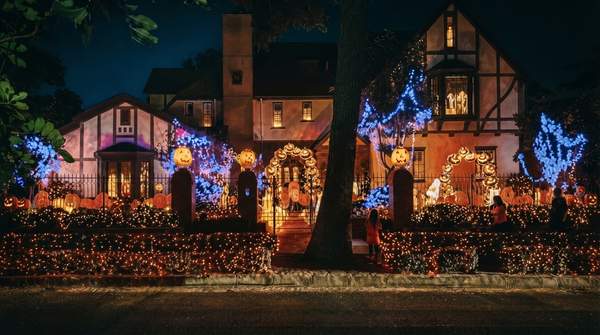
Once you're out, the measurable indicator that your timing is right is the presence of other trick-or-treaters and decorated homes in your immediate neighborhood — the city's real signal system. As a bonus tip from experienced Chicago trick-or-treaters reported by Block Club Chicago: a teal pumpkin on a porch means allergy-friendly or non-food treats, and a child carrying a blue pumpkin may be non-verbal or have autism or sensory processing differences, per the National Autism Association. When the decorated houses on your block are lit and the sidewalk fills with costumes, you've found your window — no city announcement required.
Sources
- When Does Trick-Or-Treating Start In Chicago On Halloween? — Block Club Chicago
- Do trick-or-treat times for the Chicago area change when Halloween falls on a weekend? — NBC Chicago
- When Does Trick-Or-Treating Start In Chicago Saturday? — Block Club Chicago