Joining a community garden in Chicago means choosing between two distinct routes: gardens run by the Chicago Park District inside public parks, and independent, neighborhood-led gardens supported by organizations like the Chicago Community Gardeners Association. Each pathway has its own contacts, processes, and engagement styles, and picking the right one first saves you from fragmented, frustrating research. Here is how both work, what garden types you will encounter, and how to take your first step.
Navigating Chicago's Community Garden Landscape
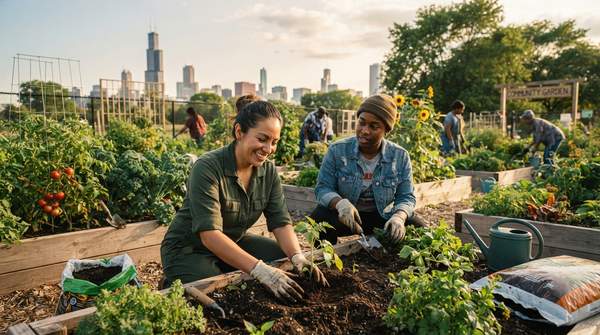
Chicago's community gardens are not one uniform system. Some sit inside public parks and are administered through official channels, with formal applications and documented guidelines. Others are run by neighborhood groups that set their own missions, whether that is growing food, cultivating native plants, or simply bringing neighbors together around a shared lot.
The Park District describes its gardens as welcoming "people with a range of interests and experience levels," with many volunteer opportunities across the city's parks. Independent gardens, meanwhile, tend to be shaped by whoever shows up to tend them. Understanding which type of garden you are contacting determines who you email, what you ask for, and what kind of commitment you are signing up for.
Pathway 1: Chicago Park District Community Gardens
The Park District route is the most structured path to gardening on public land. Its Community Gardens portal serves as the official application center, housing the paperwork and guidelines needed to garden legally on park property. The process is bureaucratic but straightforward: the application and renewal steps are spelled out in formal guidelines, so there is little guesswork.
According to guides familiar with the system, the crucial first step is using the Park District's interactive map and garden directory to identify a garden near you, then contacting the designated garden leader or Park District coordinator to check plot availability. Waitlists are common, so getting your name in early matters. If no existing garden suits you and you want to start a new one, be prepared to rally your neighbors: the Park District requires a dedicated group of at least 10 members to approve a new site.
Pathway 2: Independent and Community-Led Gardens
Independent gardens operate outside the Park District's application system, and joining one means contacting the garden group directly. A concrete example is the Lakeview Community Garden at Fletcher, a group of Chicago gardeners who came together to grow. Started in October 2014, the garden moved from a lot near the Belmont train station to its permanent home at 935 W. Fletcher. Its listed purpose goes beyond food: gardening "helps build stronger communities by connecting gardeners to their neighbors, improve health and encourages a sustainable lifestyle." Interested gardeners can reach it by email.
These gardens' missions are determined by the local community or managing organization, so one may emphasize food production while another focuses on native plants or beautification. Participation typically involves collective effort and shared stewardship rather than an individually assigned plot alone. To find such gardens and connect with the wider network, the Chicago Community Gardeners Association (CCGA) is a key resource.
Understanding Garden Models: Allotment, Communal, and Ornamental
Before contacting anyone, know the vocabulary, because the type of garden shapes your role. The Park District describes its "edible" gardens as featuring several distinct opportunities: allotment plot gardening, pantry gardening, and children's learning gardens.
- Allotment plots: You tend your own assigned plot and typically keep what you grow.
- Pantry gardens: The harvest is grown collectively for donation, so your effort feeds the neighborhood.
- Children's learning gardens: Education-focused spaces where gardening doubles as youth programming.
- Ornamental gardens: Many Park District gardens focus on native plants, shrubs, and annual and perennial flowers, prioritizing beautification over food.
Specific models vary by individual garden within the park system, so confirm which model a particular garden uses before assuming you will get a personal plot.
Chicago Community Garden Pathways Decision Framework
Use this matrix to match your situation to the right first move. The classification is simple: if your priority is a formal plot on public park land, start with the Park District; if you want neighborhood-run community engagement, start with independent gardens and their support networks.
| Pathway | Typical Garden Focus | Key Contacts | Engagement Model |
|---|---|---|---|
| Chicago Park District gardens (located in public parks) | Ornamental/native plant gardens, edible gardens (allotment plots, pantry gardens), children's learning gardens | Chicago Park District; garden leader or Park District coordinator for the specific site | Individual allotment plots or communal volunteering; formal application and renewal guidelines |
| Independent, community-led gardens | Community engagement, food production, native plants, neighborhood beautification — set by each local group | Individual garden groups directly (e.g., Lakeview Community Garden at Fletcher by email); CCGA for network support | Collective effort and shared stewardship; volunteer activities |
The trade-off: the Park District offers a clear, documented process and official plot access, but with bureaucracy and common waitlists. Independent gardens offer immediate community connection and flexible missions, but require you to find and approach each group yourself, with terms set locally.
Making Your Choice: Key Considerations for Gardeners
Ask yourself what you actually want from the experience. If you want your own space to grow vegetables and value a defined, legitimate process, a Park District allotment plot fits best — accept that you may wait. If your goal is donating produce or joining youth education, seek out pantry or learning gardens and ask coordinators specifically about those models.
If your priority is neighborhood connection — meeting neighbors, sharing stewardship of a shared space — an independent garden like the Fletcher Street group may suit you better. There, participation means collective effort rather than a private plot. Your experience level matters less than your willingness to show up: the Park District explicitly welcomes a range of interests and experience levels, and independent gardens are built around the people who join.
Next Steps: How to Get Involved
For the Park District route, go to its Community Gardens portal, use the interactive map to find gardens in your neighborhood, and contact the garden leader or Park District coordinator about plot availability. Ask early, since waitlists are common, and confirm whether the garden uses allotment, pantry, or ornamental models.
For the independent route, email the garden directly — the Lakeview garden, for instance, lists a contact email — and connect with the broader community through the CCGA. Its community gardening forum, created after feedback from gardeners at the 2018 conference, is open to all; to join, email your name and email address to the association's communications address, and you should receive a welcome email within 24 hours with full access to post questions and find gardens.
Your Next Step: Finding Your Chicago Community Garden
Identify whether a Chicago Park District garden or an independent community-led garden aligns best with your gardening goals and preferred engagement model. The measurable indicator of progress is simple: you have successfully located contact information for the Chicago Park District or a relevant independent garden organization such as NeighborSpace or CCGA, and made your initial inquiry. Once you have sent that first email or spoken with a garden coordinator about availability, you are officially in the pipeline — and on a waitlist, an early name is the best advantage you can have.
Sources
- CCGA Community Gardening Forum - Chicago Community Gardeners Association — Chicago Community Gardeners Association - Learn Connect Grow
- Community Gardens — Chicago Park District
- Parks & Community Gardens — Alderman Bennett Lawson - 44th Ward Chicago
- My Guide to 7 Amazing Chicago Community Gardens & Resources for 2026 – Litter Caterpillars — Littercaterpillars