When communities seek to improve local safety, they can choose from a variety of strategies that extend far beyond traditional watch groups. These initiatives range from volunteer-driven tactical interventions to deeply integrated partnerships with city government, each with distinct goals, operational structures, and resource needs. Understanding these differences is key to selecting an approach that fits a neighborhood's specific challenges and capacity. Three prominent models offer different paths toward a safer community. Volunteer-led School Streets provide a focused, hands-on solution to a specific problem. Placemaking and equitable development projects take a broader, long-term view by addressing the environmental and economic roots of safety concerns. Finally, formal resident-government partnerships, such as New York City's NeighborhoodStat program, create institutional channels for residents to co-create public safety solutions with city agencies.
Model 1: Volunteer-Led School Streets
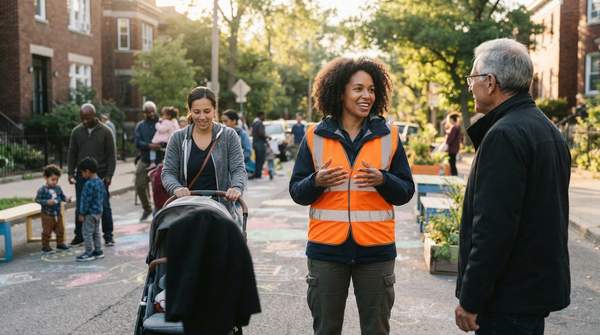
School Street initiatives are highly focused programs designed to create safer, healthier, and more active environments for children. The primary goal is to temporarily restrict motor vehicle access on streets near schools during the busy drop-off and pick-up times. This model is defined by its reliance on direct community action and a hands-on operational structure that empowers local residents to reshape their immediate environment. The experience is often rewarding for participants. A Canadian study of School Streets found that over 90% of volunteers were highly satisfied with their involvement.
According to the study, 87% felt they made a tangible contribution to child safety, and 85% reported developing stronger connections within their community. The manageable time commitment, often a single 40-minute shift, was a key factor in this positive reception. Operationally, these programs depend entirely on a consistent pool of volunteers to manage daily logistics. Key activities involve the physical work of setting up and removing road closures, which can include moving heavy signs and barriers. While effective, this model faces challenges related to sustainability and resources. Volunteers have noted that the lack of secure, dry storage for equipment can be a significant limitation.
Some participants also suggest that for long-term success, the role of program coordinator should be a paid position, and that cities and school boards should eventually invest in permanent infrastructure to ensure safety, reducing the reliance on daily volunteer labor.
Model 2: Placemaking and Equitable Development
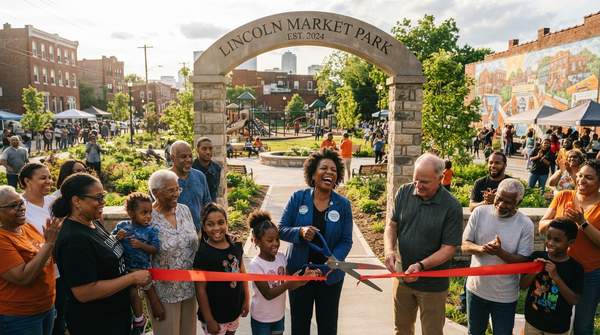
A second approach to community safety, placemaking and equitable development, takes a much broader, systemic view. Instead of focusing on a specific time or location, these initiatives aim to address the root causes of crime by improving a neighborhood's physical environment and fostering economic vitality. This model operates on the principle that investments in public spaces and community well-being are fundamental public safety strategies. This "ecosystem approach" is exemplified by efforts in Washington, D.C.'s Anacostia neighborhood. There, local leaders developed a community-led Equitable Development Plan to invest in public spaces and built-environment improvements, filling gaps in citywide violence prevention efforts.
According to a report from the Local Initiatives Support Corporation, such investments, which are not always thought of as public safety tools, can have a greater impact than more punitive measures. Key activities often include improving street lighting, establishing clean corridors, and creating or enhancing youth recreation opportunities. Unlike volunteer-heavy models, these initiatives demand extensive collaboration and significant, sustainable funding. Success requires a coordinated effort between city agencies, private partners, nonprofits, and residents to co-create a shared vision. A critical component is long-term financial support. As one analysis from Brookings notes, grassroots organizations need sustainable, multi-year commitments, often allocated through municipal budgets, to deliver transformative results.
This reliance on institutional funding can also be a vulnerability; in 2025, for instance, federal funds for local safety solutions were cut by over $1 billion, leaving communities to find ways to sustain their progress.
Model 3: Resident-Government Partnerships
A third model institutionalizes community involvement through formal partnerships with government agencies, giving residents a direct and powerful voice in shaping public safety. New York City’s Mayor’s Action Plan for Neighborhood Safety (MAP) is a primary example of this approach. Launched in July 2014 in 15 public housing developments that accounted for 20% of violent crime in the city's public housing, MAP’s stated goal is not merely to decrease crime but to "build resident power to imagine and lead alternative public safety solutions in partnership with government." The operational centerpiece of MAP is a process called NeighborhoodStat (NStat).
Inspired by the data-driven police management tool CompStat, NStat reorients the process to empower residents. It brings community members and city agencies together for regular meetings to analyze neighborhood-level data, identify public safety priorities, and develop collaborative action plans. Teams of residents, facilitated by staff from the Mayor’s Office of Criminal Justice, meet weekly to discuss issues ranging from garbage collection to youth delinquency and work with agencies to realign city resources. By October 2019, 353 residents had taken on leadership roles within these stakeholder teams. Activities under this model are diverse and responsive to community-identified needs.
Residents have driven Crime Prevention Through Environmental Design (CPTED) projects, leading to the installation of new lighting and locks, as well as the improvement of green spaces and community centers. This model requires a robust institutional framework, dedicated professional staff, and city funding for both capital projects and community organizing. Its structure proved adaptable during the COVID-19 emergency, when the established community networks were immediately activated to address residents' urgent health and economic needs.
Community Safety Initiative Comparison
Choosing the right approach for a neighborhood requires a clear understanding of the trade-offs between different models. The following table compares the primary goals, operational structures, key activities, and resource needs of the three initiatives discussed.
| Initiative Model | Primary Goal | Operational Model | Key Activities | Resource Needs |
|---|---|---|---|---|
| School Street Initiatives | To create safer, healthier environments for children by temporarily restricting vehicle access around schools during drop-off and pick-up. | Relies heavily on community volunteers to manage physical barriers and signage during temporary, daily road closures. | Volunteers physically manage road closures with signs and barriers during short, recurring shifts. | Volunteer-heavy, requiring sustained time commitment for daily operations. Needs minimal funding for basic equipment like signs and barriers. |
| Placemaking & Equitable Development | To enhance public safety by addressing root causes of crime through community-centered economic investment and improving the physical environment. | Involves multi-sector collaboration across city agencies, private partners, nonprofits, and residents to develop and implement place-based strategies. | Investing in street lighting, cleaning corridors, providing youth recreation, and improving public spaces to foster community well-being. | Requires significant, sustainable institutional funding for capital investments and program support, plus coordinated efforts from various city agencies. |
| Resident-Government Partnerships | To build resident power to imagine and lead alternative public safety solutions in direct partnership with government agencies. | A formal, resident-driven process for regular meetings with city agencies to analyze data, pinpoint solutions, and realign city resources. | Residents participate in data analysis meetings, create action plans, and work with agencies to implement solutions like improved lighting or programming. | Requires institutionalized government support, professional staff to facilitate, and dedicated funding for capital projects and community organizing. |
Making an Informed Choice for Your Neighborhood
The most effective community safety initiatives are those well-matched to a neighborhood's specific context, goals, and capacity. A volunteer-driven School Street program can be an excellent starting point for a community with a clear, focused problem and a strong base of engaged residents ready to commit their time. In contrast, neighborhoods facing systemic issues rooted in decades of disinvestment may find that a placemaking or equitable development approach is necessary to create lasting change, though this requires the significant work of securing substantial funding and building multi-sector collaborations.
For communities seeking to fundamentally alter the relationship with local government and give residents a direct voice in how city resources are used, a formal partnership model like NeighborhoodStat offers a powerful mechanism for accountability and co-governance. Ultimately, communities should select a safety initiative model that aligns with their specific safety challenges, available volunteer capacity, and potential for securing institutional funding and partnerships. A community's ability to sustain the chosen initiative, evidenced by consistent volunteer engagement, successful funding acquisition, or ongoing collaboration with relevant agencies, will be the ultimate measure of its success.
Sources
- Mayor's Action Plan - Neighborhood Safety
- Promoting children’s health through community-led street interventions — PMC
- As Crime Rates Fall to Historic Lows, New Report Reveals that Neighborhood Development is a Community Safety Strategy — Local Initiatives Support Corporation
- Safety starts at the community level: Actionable lessons from three US cities — Brookings
- NeighborhoodStat: Strengthening Public Safety Through Community Empowerment — Center for American Progress