This ranked guide identifies the top five neighborhoods in Maple Creek for families with young children, evaluated by public school performance ratings, park acreage per capita, reported crime statistics, and median home sale prices. Parents and guardians prioritizing these factors in their housing search will find this list useful.
This ranking was determined by analyzing data from the Maple Creek Unified School District, the City of Maple Creek Police Department's public crime logs, the Parks & Recreation Department's asset inventory, and housing market reports from the Maple Creek Realtors Association.
1. Willow Creek — For Top-Tier Public Schools
Willow Creek is the premier choice for academic performance, with its schools consistently rated high-performing. Both Willow Creek Elementary and Northwood Middle School received the highest "Exemplary" rating from the Maple Creek Unified School District (MCUSD) on the most recent state academic performance index. This reflects a community valuing educational resources, seen in active parent-teacher associations and well-funded school programs. Residency here correlates with access to advanced placement courses and specialized STEM programs at the high school level.
Beyond the classroom, Willow Creek offers a quiet, suburban environment characterized by tree-lined streets and well-maintained single-family homes. The housing stock predominantly consists of mid-century and contemporary two-story houses on generous lots, appealing to families seeking space. However, this combination of premier schools and desirable housing comes at a significant cost. The Maple Creek Realtors Association (MCRA) reports that the median home sale price in Willow Creek was $875,000 in the last quarter, making it one of the least affordable areas in the city. This price point is a considerable limitation for many families, positioning Willow Creek as an option primarily for those with higher household incomes.
2. Oakwood Park — For Unmatched Access to Green Space
Oakwood Park, a 250-acre expanse, makes Oakwood Park ideal for families prioritizing an active, outdoor lifestyle. The neighborhood boasts 18.5 acres of public parkland per 1,000 residents, the city's highest ratio, according to the City of Maple Creek Parks & Recreation Department. The park features playgrounds, splash pads, sports fields, and paved trails for strollers and cyclists, offering abundant, cost-free daily activities. An active neighborhood association further fosters local identity through seasonal events, farmers' markets, and youth sports leagues.
In comparison to Willow Creek, Oakwood Park offers a more accessible entry point into the housing market. The MCRA places the median home price at $620,000, reflecting a housing stock primarily composed of post-war bungalows and modest ranch-style homes. While the schools in Oakwood Park are rated as "Proficient" by the MCUSD—a solid, if not top-tier, designation—they do not reach the same performance levels as those in Willow Creek. The main drawback for some buyers is the age of the homes; many properties require updates to their electrical systems, plumbing, or interior finishes. This presents a trade-off: greater affordability and recreational access in exchange for potentially necessary home renovation projects.
3. Riverbend — For Walkability and Community Engagement
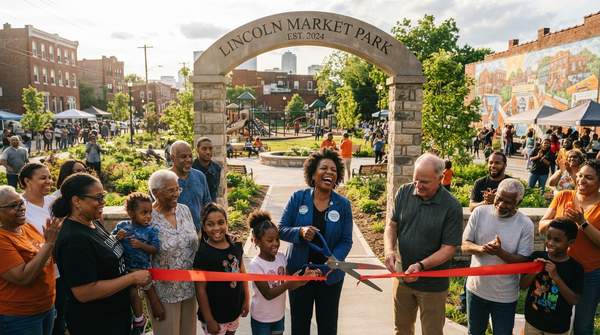
Riverbend offers a walkable, urban-lite environment with a vibrant, engaged community. Its grid-like streets, mixed-use zoning along the main thoroughfare, and central community square encourage pedestrian activity. Families can easily walk to the local library, cafes, a small grocery store, and two neighborhood parks. Dr. Elena Vance, a Maple Creek University sociologist specializing in urban planning, notes, "Riverbend's design fosters 'third places'—locations outside of home and work where community bonds are formed. This is particularly beneficial for young families seeking social support networks." This creates a dynamic atmosphere, distinct from car-dependent suburban areas.
The housing in Riverbend is diverse, including historic townhomes, duplexes, and a growing number of modern condominium developments, with a median sale price of $595,000, according to the MCRA. This variety attracts a mix of residents, from young professionals to established families. The primary limitation of Riverbend is its school zoning. While the local elementary school is well-regarded, the middle and high schools have more mixed performance records, which may be a concern for parents planning for the long term. Additionally, the neighborhood's increasing popularity has led to discussions about its changing character, a topic explored in broader contexts like gentrification and its effects on urban areas.
4. Northgate — For Affordability and New Construction
For families looking for the most budget-friendly option without sacrificing space, Northgate presents a compelling case. As one of the city's newer and still-developing areas, it offers the lowest median home price on this list, which the MCRA reports at $485,000. The vast majority of homes in Northgate are new construction, built within the last decade. This is a significant advantage for families who want to avoid the maintenance and renovation costs associated with older homes. These properties typically feature modern, open-concept floor plans, energy-efficient appliances, and the larger square footage that many growing families require. The neighborhood is also zoned for the newly constructed Northgate Elementary, which boasts modern facilities and technology.
The trade-off for this affordability and modernity is a lack of established amenities and a longer commute to the city center. Northgate currently has limited retail and dining options, requiring residents to drive to adjacent neighborhoods for most shopping and services. It's worth noting that while park space has been allocated in the master plan, development of these areas is ongoing and lags behind the residential build-out. According to the City of Maple Creek Police Department, reported property crime rates are slightly higher here than in more established neighborhoods, a trend sometimes observed in rapidly developing areas. The community infrastructure is still catching up to the population growth, making it a choice for families willing to invest in an area with future potential rather than present-day completeness.
5. Cedar Crest — For the Best Overall Balance
Cedar Crest is the best all-around option, balancing good schools, community amenities, and reasonable housing costs. It compromises between Willow Creek's high cost and Northgate's developmental stage. MCUSD rates Cedar Crest schools "Above Average," providing strong academic programs without top-ranked school competition. The neighborhood offers three well-maintained community parks and a public pool for recreation. Its modest but functional local business district includes essential services and family-friendly restaurants.
Cedar Crest's housing market is stable, with a median home price of $690,000, reported by the MCRA. Homes are primarily 1980s and 1990s split-levels and traditional two-story houses, offering a good blend of size and condition. Its main limitation is a lack of distinct "wow" factor; it doesn't boast the best schools, biggest parks, or most vibrant downtown. Instead, it offers high competency across all major criteria, making it a pragmatic choice for a reliable, low-drama environment, though not the most exciting or unique neighborhood.
| Neighborhood | Best For | Median Home Price (Q3) | Key Attribute |
|---|---|---|---|
| Willow Creek | Top-Tier Schools | $875,000 | "Exemplary" rated K-8 schools |
| Oakwood Park | Parks & Recreation | $620,000 | Highest park acreage per capita |
| Riverbend | Walkability & Community | $595,000 | Mixed-use, pedestrian-friendly core |
| Northgate | Affordability & New Homes | $485,000 | Predominantly new construction |
| Cedar Crest | Overall Balance | $690,000 | "Above Average" ratings across all criteria |
How We Chose This List
Top neighborhoods for young families were selected using a data-driven approach focused on education, recreation, safety, and housing. Neighborhoods with heavy nightlife or insufficient single-family housing stock were excluded, as they do not align with this demographic's primary needs. Criteria were weighted to reflect common parental priorities.
First, school performance was assessed using the most recent public data from the Maple Creek Unified School District, focusing on state-level performance ratings and the availability of specialized programs. Second, access to parks and recreation was quantified by analyzing the City of Maple Creek's official data on park acreage per 1,000 residents and the inventory of amenities like playgrounds and sports facilities. Third, safety was evaluated by reviewing publicly available incident reports from the Maple Creek Police Department for the past 12 months, focusing on rates of property crime and violent crime per capita. Finally, housing affordability and type were determined using quarterly market reports from the Maple Creek Realtors Association, which provided median sale prices and descriptions of the dominant housing stock. Expert commentary from Dr. Elena Vance of Maple Creek University was incorporated to provide context on community structure and walkability.
The Bottom Line
Willow Creek leads for families prioritizing public school performance with a substantial budget. Oakwood Park suits those valuing an active, outdoor lifestyle and affordability. Cedar Crest offers the most balanced option, performing strongly across all key metrics without Willow Creek's higher cost or Oakwood Park's less developed infrastructure.