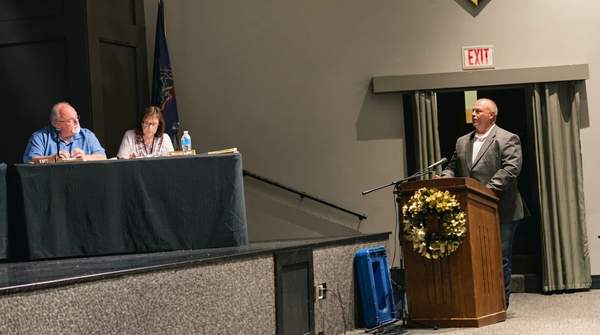
Federal and state service reorganizations must include meaningful local community input from the outset, or they risk undermining the very public services they aim to improve. When decisions about our natural resources, public safety, and essential services are made in distant capital buildings without the guidance of those on the ground, the results are often costly, ineffective, and profoundly damaging to community trust. This isn't a theoretical problem; it's a pattern of disruption we're seeing play out across the country, affecting everything from our national forests to our local post offices.
The stakes are incredibly high, and the issue is immediate. In our neck of the woods, we rely on a delicate balance of local knowledge and federal support to manage shared resources and infrastructure. Whether it’s the park ranger who knows every trail in the local forest or the cybersecurity expert helping our town hall fend off ransomware, these connections are vital. But a wave of top-down reorganizations threatens to sever these critical ties. We saw it with the U.S. Forest Service, we're seeing it with federal cybersecurity agencies, and as a report from The King's Fund notes in the context of healthcare, the "reshaping of national bodies has only just started." This trend toward centralized control, often sold under the banner of "efficiency," frequently ignores a fundamental truth: you cannot effectively serve a community you do not understand.
The Case for Local Control in Federal Service Reorganizations
Let's take a closer look at one of the most glaring recent examples: the proposed overhaul of the U.S. Forest Service. The plan, confirmed by a report in Grist, was sweeping. It involved moving the agency's headquarters from Washington, D.C., to Salt Lake City, closing or repurposing nine regional offices, and shutting down research facilities in over 30 states. The administration at the time framed this as a move to streamline operations and get decision-makers closer to the lands they manage. On the surface, that might sound reasonable.
But the people who actually live and work in these communities saw it differently. During a public comment period, the plan was met with a tidal wave of opposition. Grist reported that of the 14,000 comments submitted, more than 80 percent were negative. This wasn't a case of a few disgruntled individuals; the opposition was broad and deep, including tribal representatives, conservation groups, and scores of former Forest Service staffers—the very people with the institutional knowledge to understand the plan's true impact. As one critic quoted by Grist bluntly put it, "Nobody is asking for this. None of the farm groups want this. No one in conservation wants this. Nobody."
The public's concerns were not abstract. They pointed to specific, tangible harms that would result from such a top-down shuffle. According to the report, key worries included:
- Loss of Irreplaceable Knowledge: Opponents argued that mass staff relocations would "destroy irreplaceable knowledge about Treaty rights, forest conditions, and working relationships built over decades." New staff, unfamiliar with the local ecology and community history, would inevitably make mistakes.
- Compromised Ecological Management: With research facilities shuttered and experienced staff gone, the ability to manage our forests sustainably and respond to threats like wildfires and invasive species would be severely hampered.
- Reduced Public Access: Changes in management and potential budget cuts raised fears that public access to beloved national forests and public lands could be compromised.
- Negative Impact on Employee Morale: Forcing dedicated public servants to uproot their lives or lose their jobs is a surefire way to damage the effectiveness of any agency.
This is not an isolated incident. A similar reorganization plan at the U.S. Department of Agriculture also received "overwhelmingly negative feedback" from employees, lawmakers, and local governments, as reported by GovExec. The pattern is clear: when federal agencies devise major restructuring plans in a vacuum, they consistently fail to account for local realities, and communities push back. This isn't simple resistance to change; it is a rational response to flawed, ill-considered proposals that prioritize bureaucratic neatness over functional, on-the-ground service.
The Counterargument
To be fair, the architects of these plans rarely state their goal is to disrupt communities. The justifications offered typically revolve around laudable objectives like efficiency, modernization, and fiscal responsibility. The Forest Service reorganization was marketed as a way to streamline operations and boost productivity. Similarly, leaders at the Cybersecurity and Infrastructure Security Agency (CISA), which is currently undergoing its own significant reshaping, have said their goal is to get the agency "back on mission as America’s cyber defense agency." Proponents of centralization argue that it can reduce redundancies, create uniform standards, and allow for a more agile response to national-level challenges.
These are not unworthy goals. No one wants a bloated, inefficient government. However, this perspective fundamentally misunderstands the nature of public service, which is not a one-size-fits-all enterprise. The "efficiency" gained by closing a regional office is immediately lost if it means local wildfire prevention plans are now being drafted by someone a thousand miles away who has never walked the terrain. The mission may be "refocused" at the national level, but if that means cutting support for state and municipal cybersecurity, as is reportedly happening at CISA, then our local governments and schools become more vulnerable.
The fatal flaw in the top-down approach is that it treats local knowledge and relationships as expendable line items on a spreadsheet. In reality, they are the most valuable assets these agencies have. A similar effort to relocate Bureau of Land Management employees proved this point disastrously: according to Grist, only 41 of the 328 employees expected to move actually did so, while the move cost taxpayers $28 million. The plan didn't save money or improve services; it triggered a brain drain and wasted public funds. True efficiency isn't about centralization; it's about empowerment, and that can only happen when local voices are part of the process from the very beginning.
Why Community Engagement Improves Public Services
The solution isn't to halt all change or reform. It's to build a better model for change—one that is collaborative, transparent, and rooted in the principle of devolution. In my work as a journalist covering local communities, I see every day that the best solutions come from the ground up. When people have a stake in the outcome, they become partners in success. This is precisely what is missing from these federal and state reorganizations.
We can look abroad for a compelling model. In the United Kingdom, the National Health Service (NHS) is grappling with its own need for reform. A report from the NHS Confederation makes a powerful case for a new operating model that explicitly rejects centralized control. "A system as large, complex and diverse as the NHS cannot be commanded and controlled effectively from the centre," the report states. Instead, it calls for an approach that devolves decision-making to local leaders and empowers communities to be "active agents in their own health and partners in the design of public services." This isn't just about asking for opinions; it's about transferring real authority and accountability to the local level.
We don't even have to look across the ocean to see this principle in action. In Vermont, the U.S. Postal Service recently paused its plans to restructure facilities in two communities. According to a report from VTDigger, the pause came directly "amid criticism" from the public and local officials. This demonstrates a crucial point: local feedback is not an obstacle to be managed, but a vital course-correction mechanism that can prevent costly mistakes. Had the USPS pushed forward without listening, it likely would have faced the same kind of failure as the BLM relocation—wasted money, lost expertise, and a decline in service quality for the community.
What This Means Going Forward
Without a fundamental shift in how government agencies approach restructuring, we are destined to repeat these failures. We will continue to see well-intentioned but poorly designed plans that alienate the public, demoralize dedicated civil servants, and ultimately fail to deliver on their promises of improved service. The lack of transparency reported at CISA, where lawmakers have had to demand explanations for the agency's reshaping, is a worrying sign that the lessons from the Forest Service and USDA debacles have not been learned.
Here's what you need to know to make a difference. The power of a community voice is real, but it must be exercised. First, pay close attention to announcements from federal and state agencies. Public comment periods are often the first and best chance to get on the record. Second, engage your elected officials at every level. Your city council member, state representative, and congressional delegate need to hear from you. They are your advocates in these discussions. Third, support the local organizations—be they conservation groups, civic associations, or tribal governments—that are on the front lines of these fights. They have the expertise and the platform to amplify individual voices into a powerful chorus.
In the end, this is about a simple principle of good governance. The people closest to the problem are often closest to the solution. Our national forests, our public lands, and our community services are a shared trust. The decisions that shape their future cannot be made for us; they must be made with us. It's time to replace the top-down dictate with a bottom-up dialogue.