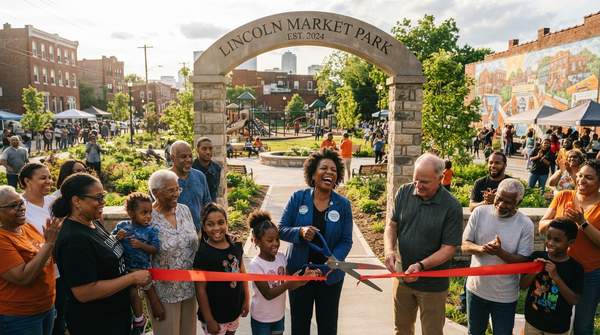
In qualitative interviews, 100 percent of participants involved in neighborhood revitalization efforts cited resident engagement as the critical factor for facilitating community benefit, capacity, or sustainability. An overwhelming consensus from those on the ground shows that local involvement is not just beneficial, but foundational for successful community engagement driving neighborhood revitalization. Effective local models for 2026 must prioritize this direct input to ensure projects align with the actual needs and aspirations of the people they serve.
However, many revitalization initiatives are launched with substantial external funding and support, yet their long-term success and true community benefit are directly proportional to the level of resident control, not simply the scale of external investment. This often creates a fundamental tension: well-intentioned external resources can fall short if they do not empower the very residents they aim to help.
Ultimately, without genuinely empowering local residents and establishing shared governance, revitalization efforts risk superficial improvements that fail to build lasting social capital or address underlying community needs, despite significant financial inputs. This perspective challenges traditional top-down approaches, advocating for a shift towards models that prioritize local agency and decision-making.
Defining Community-Led Revitalization
Community-led revitalization involves empowering residents to actively shape the future of their neighborhoods. For example, a study in Flint, Michigan, interviewed 18 residents and stakeholders who were implementing Community-Engaged Crime Prevention Through Environmental Design (CE-CPTED) initiatives. This direct involvement goes beyond mere consultation, placing decision-making power in the hands of those most affected by local changes.
The immediate positive effects of such engagement are substantial. Participants across all three neighborhoods in the Flint study reported that CE-CPTED was associated with positive street activity, an enhanced sense of community, and increased collective efficacy, according to revisiting revitalization: exploring how structural determinants .... Outcomes demonstrate that when residents are truly at the helm, their efforts create a ripple effect, improving not just physical spaces but also strengthening the social fabric and overall health of the community. This active participation fosters a sense of ownership and shared responsibility that is difficult to achieve through external interventions alone.

This approach moves beyond simply fixing visible problems. Instead, it cultivates an environment where residents feel empowered to identify their own challenges and develop tailored solutions. By doing so, community-led models ensure that revitalization efforts are culturally relevant and directly address the unique needs of each neighborhood, fostering sustainable change from within.
The Crucial Role of Resident Control
While engagement is important, the degree of resident control emerges as a critical differentiator for achieving deeper, more equitable, and sustainable outcomes in neighborhood revitalization. A key finding from the Flint study, published in revisiting revitalization: exploring how structural determinants ... revealed that participants from neighborhoods with higher resident control over CE-CPTED reported significantly more social capital and behavioral action compared to those with less resident control. Simply participating is not enough; true decision-making power directly correlates with stronger community bonds and collective action.
The distinction highlights the tension between superficial engagement and genuine empowerment. External investment in community revitalization is largely wasted without direct resident control, which is the sole driver of sustainable social capital and collective efficacy. When residents have a real say in how resources are allocated and projects are implemented, they are more invested in the long-term success and maintenance of those initiatives. This deepens the impact far beyond initial funding cycles.
Establishing shared governance structures represents a promising approach to foster equitable decision-making and outcomes in urban regeneration, according to the same PMC study. Such structures ensure that local voices are not just heard, but hold legitimate authority in the planning and execution phases. This direct power transforms passive recipients into active shapers of their environment, leading to more resilient communities capable of addressing future challenges autonomously.
Federal Support Meets Local Realities
Federal programs often aim to bolster community revitalization, yet their design may not always align with the proven benefits of strong resident control. The Obama White House's Neighborhood Revitalization Initiative (NRI), for instance, engaged multiple federal departments, including HUD, Education, Justice, HHS, and Treasury, to support local solutions. Broad coordination underscores a commitment to addressing complex urban challenges through integrated place-based programs.
The NRI focused on providing flexible grants, building neighborhood capacity through technical assistance, and sharing best practices, as detailed on the neighborhood revitalization initiative | the white house archive. While these supports are crucial, they imply a top-down approach to empowering communities. This contrasts with the PMC study's finding that higher resident control, a bottom-up power structure, directly leads to more social capital and behavioral action. This means federal support, while well-intentioned, may not be structured to maximize the most impactful form of local agency.
Federal programs like the NRI, which emphasize 'building neighborhood capacity through technical assistance,' may be inadvertently perpetuating a top-down model. This risks missing the critical insight from the Flint study that true social capital and collective efficacy are directly proportional to resident control, not just external support or training. While significant federal resources and coordinated efforts provide a vital foundation, their effectiveness is ultimately mediated by how well they adapt to and empower the specific realities of local communities. For revitalization efforts to truly flourish, federal strategies must evolve to integrate genuine local control into their core design.
The Long-Term Impact of Engagement
Community engagement is not merely a best practice; it is a fundamental requirement for achieving truly sustainable, equitable, and impactful neighborhood revitalization. For instance, a pilot program concluded in 2023 saw all 10 participating communities achieve measurable improvements in neighborhood conditions, according to Habitat. Tangible results highlight the direct link between active community involvement and observable positive change, demonstrating that engagement yields concrete benefits.
Beyond physical improvements, revitalization efforts profoundly influence the social environment and structural determinants of material resources. The process of vacant housing revitalization, for example, impacts residents' health by altering both the physical surroundings and fostering community engagement, as noted in the PMC study. The connection means that investments in physical infrastructure, when coupled with resident control, can also lead to better health outcomes and a more robust social fabric.
Improvements in neighborhood conditions and health outcomes underscore that when community engagement is genuinely integrated, it drives large-scale, sustainable positive change. This long-term impact extends beyond the immediate project scope, building lasting capacity within communities to self-manage and adapt. Sustainable revitalization, therefore, is intrinsically tied to empowering residents to shape their own environments, ensuring that changes endure and benefit future generations.
Addressing Complexities and Challenges
Why are the outcomes of vacant housing revitalization often debated, even with significant investment?
The outcomes of vacant housing revitalization efforts are often contested and require a nuanced understanding of resident responses and adaptations, according to the revisiting revitalization: exploring how structural determinants ... study. This debate arises because physical improvements alone do not guarantee social benefits or resident satisfaction. Without direct resident control and input into the planning, projects can inadvertently displace existing communities or fail to address underlying social and economic needs, leading to mixed perceptions of success.
ow do federal capacity-building efforts sometimes fall short in fostering true community empowerment?Federal initiatives often focus on 'building neighborhood capacity through technical assistance' and providing 'flexible grants,' as seen in the Obama White House's NRI program. However, this top-down approach can fall short because true social capital and collective efficacy are directly proportional to resident control, not just external support or training, as highlighted by the Flint study. This suggests a fundamental mismatch in how 'capacity' is defined, often overlooking the necessity of direct local decision-making power.
How can large-scale financial investments in physical improvements better ensure sustainable community benefits?
Companies and philanthropic organizations investing in large-scale housing initiatives are likely to find their 'success' measured primarily in units built, such as the aim to build or preserve 2,000 to 3,000 affordable housing units. However, the more profound and sustainable social benefits will remain elusive without a fundamental shift towards resident-led governance structures. Integrating resident decision-making power from the outset helps ensure that physical improvements align with community needs and foster long-term social capital, moving beyond purely quantitative metrics.
The Path Forward: Investing in People and Places
The path forward for neighborhood revitalization in 2026 clearly points towards prioritizing resident control as the cornerstone of any successful initiative. Large-scale financial commitments, such as a housing initiative seeking to create a fund of up to $100 to $150 million in equity commitments, represent significant potential. However, these investments alone are insufficient to guarantee sustainable community benefits. The Federal City Council's housing initiative, for example, aims to build or preserve 2,000 to 3,000 affordable housing units, according to Federalcitycouncil.
Companies and philanthropic organizations investing in such large-scale housing initiatives are likely to find their 'success' measured only in units built. Yet, the more profound and sustainable social benefits, as highlighted by the 'contested outcomes' of revitalization efforts, will remain elusive without a fundamental shift towards resident-led governance structures. This means that while capital is essential, it must be deployed in a manner that genuinely empowers local decision-makers rather than bypassing them.
Moving beyond 2026, the real impact of revitalization efforts will be judged not just by the dollars spent or structures erected, but by the social capital generated and the collective efficacy fostered within communities. For example, a new pilot program launching in Q3 2026 focused on community-led green space development will likely succeed if it grants residents direct control over design and implementation, ensuring that significant investments genuinely translate into lasting community well-being.