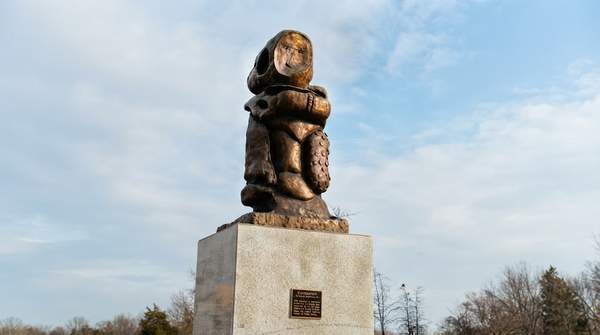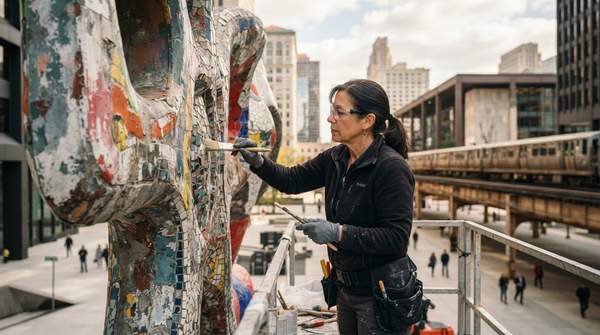
Chicago's public art is cared for by two separate administrative systems, and knowing which one governs a specific artwork starts with a simple question: where is it located? The city's Department of Cultural Affairs and Special Events (DCASE) manages the municipal Percent-For-Art collection found in airports, transit hubs, viaducts, and other public sites. Chicago Public Schools (CPS) owns and maintains its own extensive fine art collection, distributed across elementary schools, high schools, and administrative buildings. This guide explains both systems and gives you a framework to identify the correct authority for any piece you encounter.
Understanding Chicago's Public Art Landscape
Chicago's public art landscape is broader than most residents realize, and responsibility for it is divided rather than centralized. On one side sits DCASE, which runs the city's Percent-For-Art Public Art Program. On the other sits the Chicago Board of Education, which owns what CPS policy formally calls "an extensive collection of artworks" spread throughout school and administrative facilities across the city.
The two collections operate under different legal foundations. DCASE's program is grounded in a City Ordinance that allocates 1.33% of qualifying capital projects toward public art. The CPS collection is governed by a formal Board policy—Section 802.2, adopted by the Chicago Board of Education on February 26, 2020—which covers the acquisition, ownership, conservation, and maintenance of the district's works of art.
That distinction matters in practice. A mural in a downtown plaza and a painting hanging in a neighborhood school may both be public art in the everyday sense, but they answer to entirely different custodians, budgets, and reporting structures. Before you raise a concern about a damaged or neglected piece, you need to know which system it belongs to.
DCASE: Managing the City's Public Art Collection
DCASE's Public Art team is the steward of the city's municipal collection. By City Ordinance, the Percent-For-Art program allocates 1.33% of qualifying capital projects toward public art. The team also manages public art projects initiated by City Council members through discretionary funds and participatory budgeting.
The scale of the current workload is substantial. For 2025, the DCASE Public Art team is overseeing nearly 40 public art projects across 19 wards, including sites such as airports, transit hubs, and viaducts, with total public art investments amounting to $10 million.
Maintenance is an explicit part of the team's mandate. Nathan Mason, a DCASE public art staff member, described his role in a department staff spotlight: "I oversee the maintenance of the public art collection." That in-house oversight means the city's collection has a named custodial function within the department, not just an acquisition pipeline.
For graffiti specifically, Chicago residents have a general-purpose route: the city's 311 service, operated through the Department of Streets & Sanitation, handles graffiti removal requests free of charge for Chicago residents. That channel applies to graffiti broadly, including graffiti on public art, and does not require you to first identify the artwork's managing department.
Chicago Public Schools: Art on School Grounds
Art on CPS property follows a different rulebook. The Board of Education's policy, adopted February 26, 2020, rescinded an earlier 2000 policy and replaced it with a broader framework. The stated purpose of the change, according to the policy document, was "to broaden the scope of the policy to include a clearer focus on equity and to ensure the districts' fine art collection has oversight from the appropriate CPS departments."
Day-to-day care falls to the Board's Designees. Under the policy, they must ensure that all works of art are installed and labeled—or, if not displayed, properly protected and stored. The Designees may also appoint a Collection Manager or similar outside consultant to ensure the collection is inspected, labeled, catalogued, and photo documented. Note that the policy permits such an appointment; it does not establish that one is currently in place.
The policy also assigns the Collection Manager or Designee several ongoing duties: providing written procedures and training for monitoring, handling, and care of collections to schools and administrative offices; ensuring newly commissioned works, including public art, comply with design, fabrication, and installation specifications established by the Board's Designees; and reporting annually to the Board and the CPS Department of Risk Management on each work of art in the collection. That annual reporting requirement gives the school system a built-in condition check that the city collection does not formally mirror.
Who Manages Chicago's Public Art? A Decision Framework
Use the location of the artwork as your diagnostic starting point. The framework below walks through the two branches you will encounter in Chicago.
| If the artwork is… | Then the responsible entity is… | Why |
|---|---|---|
| On CPS property—an elementary school, high school, or administrative building | Chicago Public Schools, under Board policy Section 802.2 | The Board owns the collection and assigns care to its Designees, with a Collection Manager handling inventory, conservation, maintenance, and annual condition reporting. |
| In a city airport, transit hub, viaduct, or other public site | DCASE's Public Art team | DCASE manages the Percent-For-Art program, funded by 1.33% of qualifying capital projects, and its staff oversee maintenance of the collection. |
| Tagged with graffiti, regardless of managing department | Report via the city's 311 service | Graffiti removal is handled by the Department of Streets & Sanitation, free for Chicago residents. |
The key boundary is property type, not artistic medium. A sculpture in a school courtyard belongs to the CPS system even if it resembles works in the city collection; a mural on a viaduct belongs to DCASE even if it sits a block from a school. When in doubt, the presence of a school building is the strongest signal that CPS policy governs the piece.
Navigating Public Art Care in Chicago
To report an issue with public art in Chicago, first identify if the artwork is on Chicago Public Schools property or in other public city sites. For graffiti on any public art, use the city's 311 service. A successful report to the correct entity—DCASE for the city collection, CPS for school-property works, or 311 for graffiti—and subsequent acknowledgment or action regarding the reported issue is the measurable sign that your concern reached the right custodian.