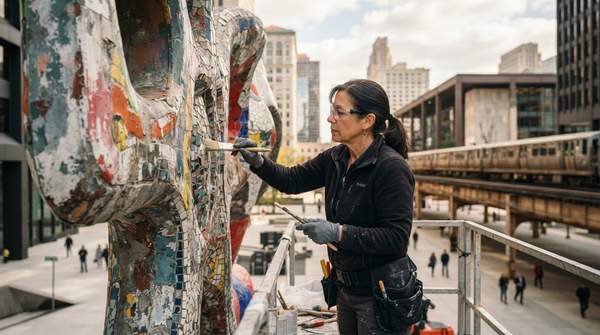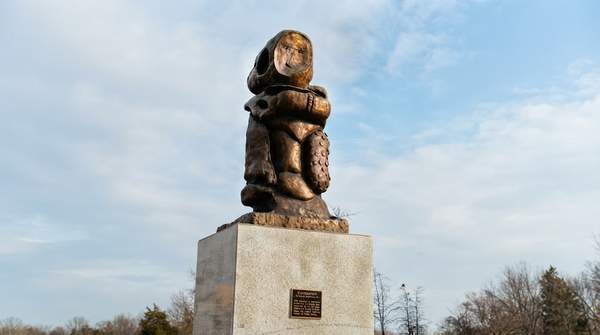
Chicago's public art has no single caretaker. Instead, responsibility is divided among separate public bodies, each with its own collection, its own money, and its own rules. The Department of Cultural Affairs and Special Events (DCASE) maintains the city's official Chicago Public Art Collection. The Chicago Public Schools board owns and cares for an entirely separate Works of Art Collection spread across school buildings. Other governmental units, including the Chicago Transit Authority and the Chicago Park District, sit outside both systems and are brought in only case by case. Understanding who owns a piece is the first step to understanding who fixes it.
Chicago's Decentralized Public Art Stewardship
The fragmentation is visible in the city's own guidance. DCASE's Percent for Art guidelines describe convening public forums for new commissions where representatives of "other City of Chicago departments and other governmental units (e.g., CTA, Chicago Park District, Chicago Public Schools) that may be involved in or affected by the work" participate. In other words, even the city's flagship public art program treats these agencies as separate stakeholders rather than as parts of one managed collection.
That structure has practical consequences for you as a resident or art enthusiast. A mural at a school, a sculpture at a library, and a piece at a transit facility may all be "Chicago public art," but each falls under a different custodian with a different budget and a different policy manual. There is no shared maintenance standard binding them together, and each entity's official materials describe only its own holdings.
Department of Cultural Affairs and Special Events (DCASE)
DCASE runs the Chicago Public Art Program and is responsible for maintaining the hundreds of artworks installed as part of the Chicago Public Art Collection. Its scope also includes deciding whether to accept proposed donations of artwork, where donated works should be installed, and how best to display them.
New acquisitions are funded by the Percent for Art ordinance, which directs 1.33% of the construction budget for the construction or major renovation of any City-owned or City-financed building or structure—or certain outdoor improvements—toward commissioning art at that site. The city's guidelines note that qualifying projects include libraries, police stations, fire houses, senior centers and others.
Maintenance of existing works is a separate matter. DCASE's own program description acknowledges that artworks are affected by light, wind, dust, temperature and humidity changes, vibration, precipitation, accidents and vandalism, and that "without long-term maintenance, the artworks risk serious degradation as the collection ages." For that work, the Public Art Program has what the city describes as a limited, annual conservation budget used to maintain, preserve and protect the collection.
Chicago Public Schools (CPS) Art Collection
The CPS collection operates under its own board policy. Every work of art qualifying as part of the Collection—whether donated to the board, donated to an individual school, or purchased by the board or a school—is the sole property of the Board of Education, regardless of where the artwork is located. The district states a commitment to equitably distribute the Collection across its facilities.
The policy also governs what happens when a work leaves the collection. A deaccessioned piece may be sold, traded, offered at public auction, donated, or discarded responsibly, with donated or philanthropically purchased works first offered to another educational institution. Funds received from sales of deaccessioned works must be used to fund arts education or other acquisitions for the Collection. Works identified as part of the WPA collection are handled differently: the board's designees work with the Fine Arts Office of the General Services Administration to return them to federal government possession.
Day-to-day oversight rests with the Board's designees, who review and approve or deny requests concerning the Collection in keeping with board policies, the Collection's mission statement, design specifications, WPA limitations and other legal restrictions.
Comparative Overview of Chicago's Public Art Custodians
The table below places the major custodians side by side, so you can identify which public body is likely responsible for a given piece and see how differently their collections are managed.
| Entity | Primary Collection Scope | Funding Source(s) | Stated Maintenance/Conservation Role |
|---|---|---|---|
| Department of Cultural Affairs and Special Events (DCASE) | The Chicago Public Art Collection—hundreds of installed works, including Percent for Art commissions at city-owned or city-financed buildings such as libraries, police stations, fire houses and senior centers. | Percent for Art ordinance: 1.33% of construction budgets for city-owned or financed buildings and certain outdoor improvements funds new commissions; a limited annual conservation budget covers existing works. | Responsible for maintaining the collection, accepting and placing donations, and preventing degradation from weather, vibration, accidents and vandalism. |
| Chicago Public Schools (CPS) | The CPS Works of Art Collection—all qualifying works are sole property of the Board of Education regardless of location, with a stated aim of equitable distribution across facilities. | Sales of deaccessioned works must fund arts education or other acquisitions for the Collection. | The Board and its designees are responsible for the Collection's care, reviewing requests for display, promotion, deaccession or sale, subject to WPA and other legal restrictions. |
| Chicago Transit Authority (CTA) | Not defined as a collection custodian in the supplied city policies; DCASE's guidelines list the CTA among governmental units that may be involved in or affected by public art projects. | Not specified in the supplied city policies. | Participates in DCASE-convened public forums on a project-by-project basis rather than under a stated collection-wide maintenance policy. |
Read side by side, the comparison shows three different philosophies: DCASE pairs a commissioning engine with a modest conservation budget, CPS ties its collection's lifecycle to education funding, and the CTA appears in city policy as a project participant rather than a collection steward. This is the fragmented system in miniature.
Challenges in Maintaining Chicago's Public Art
The official policies are candid about the physical risks. DCASE's program description lists exposure to natural and artificial light, wind, air-borne dust, temperature and humidity changes, vibration, precipitation, accident and vandalism as ongoing threats, and warns that without long-term maintenance the artworks risk serious degradation as the collection ages. The city's own characterization of its conservation budget as "limited" signals that the resources dedicated to this fight are constrained.
The structural challenge may be larger than the physical one. Each custodian documents only its own holdings: DCASE describes the Chicago Public Art Collection, CPS policy covers the school system's works, and no consolidated inventory spanning all owners appears in any of these official materials. For a resident trying to report damage or track the condition of a specific piece, that means first identifying the owner—and the answer differs block by block.
Navigating Chicago's Public Art Landscape
To understand the maintenance and preservation of Chicago's public art, residents and enthusiasts must recognize the decentralized nature of its stewardship, with distinct responsibilities and funding mechanisms across various city entities. Practically, that means starting with location: art at a library or city building points to DCASE, art inside a school points to the Board of Education, and transit-related works require asking the CTA directly.
The clearest measure of whether this fragmented system is improving is the presence or absence of a consolidated, publicly accessible inventory of Chicago's public art, including its condition and responsible custodian. Today, each agency's materials cover only its own slice; the emergence of a single cross-agency record would be the concrete milestone showing the city is closing the gap between its stated conservation commitments and the realities of a collection scattered across many hands.