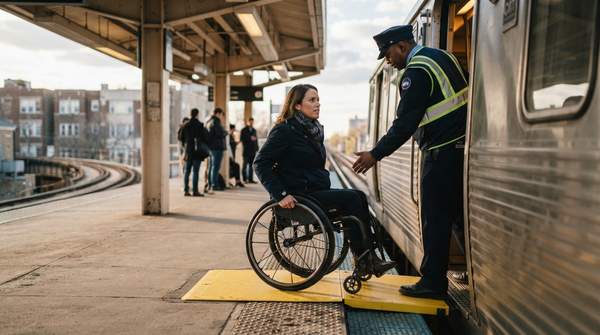
Both of Chicago's major transit systems are broadly accessible, but they differ in ways that matter for trip planning. Every CTA bus and railcar is accessible, yet not every CTA station is. Metra trains are accessible across all lines, but its stations fall into three tiers, and dozens remain inaccessible. The practical upshot: on CTA, plan around the station; on Metra, plan around the station category. This guide compares the two systems side by side and explains how to get reduced fares, travel training, and real-time accessibility information.
Understanding CTA and Metra Accessibility for Your Commute
CTA operates the city's buses and the "L" rail network; Metra runs the regional commuter rail system. Both fall under the accessibility umbrella of the ADA, and both participate in fare and assistance programs managed regionally. According to the Northern Illinois Transit Authority, CTA, Metra, Pace, and the RTA are continuously working to make the regional transit system more accessible, and riders are encouraged to explore the RTA's Travel Assistance Digital Library for additional resources.
The key planning distinction is station coverage. The CTA says 110 of its 146 rail stations are accessible, with its All Stations Accessibility Program serving as the roadmap to make the whole system accessible, according to the transit guide ChiTransit. Metra, by contrast, sorts its stations into fully accessible, partially accessible, and non-accessible categories, which changes what a rider can expect at each stop.
CTA vs. Metra: Accessibility at a Glance
The table below juxtaposes the two systems across four dimensions: vehicles, stations, fares, and assistance. The comparison shows that vehicle accessibility is largely solved on both systems, while station access is where the systems diverge most.
| Dimension | CTA | Metra |
|---|---|---|
| Vehicle accessibility | All buses have ramps at the forward doors, priority seating, wheelchair securement areas, and automated voice announcements with LED text displays. All trains have accessible features, including wheelchair securement locations inside cars. | All trains are accessible for wheelchairs and mobility devices, with automatic audible stop calling on all trains and audible arrival announcements at outlying stations. Conductors and station staff are trained to assist customers with disabilities. |
| Station accessibility | 110 of 146 rail stations are accessible; the All Stations Accessibility Program is the roadmap to full accessibility. Not all stations are currently accessible, requiring pre-trip planning. | 186 fully accessible stations, 13 partially accessible, and 44 inaccessible. Partially accessible stations allow platform access from the street, but ramps, ticket windows, buildings and shelters may not fully conform to ADA guidelines. Non-accessible stations are usually elevated with only stairs. |
| Fare programs | Both participate in the RTA-managed Reduced Fare and Ride Free programs: a reduced fare permit enables fare products at about half-price, and riders with disabilities enrolled in the Illinois Department on Aging's Benefit Access program ride free on fixed-route service. | |
| Rider assistance | Priority seating decals, used regionally since 2012, rank wheelchair and scooter users first; operators must clear the securement area when needed. | Elevator Status Hotline (312-322-6925) for real-time elevator availability; service animals permitted on any open car; accessibility materials available in braille on request. |
Two qualifications deserve emphasis. CTA ranks priority seating for riders who use manual or power wheelchairs or scooters first, and operators must request that priority seats be cleared if the securement area is occupied by anyone else. On Metra, customers with mobility devices and service animals are welcome on all lines, and service animals are permitted on any open car.
Fare Programs and Financial Assistance
The Regional Transportation Authority manages the Reduced Fare and Ride Free programs covering CTA, Metra, and Pace. Riders with qualifying disabilities can apply for a reduced fare permit, which enables the purchase of fare products at about half-price. Applications are available at Fares.RTAChicago.org, or the Reduced Fare Application can be downloaded directly.
Riders with a disability who are enrolled in the Illinois Department on Aging's Benefit Access program are eligible to ride free on CTA, Metra, and Pace fixed-route services. Enrollment in Benefit Access is a prerequisite, so riders who want free travel need to complete that state program first. For questions about either program, the RTA's customer service line for Reduced Fare and Ride Free programs is 312-913-3110.
Rider Assistance and Planning Resources
Beyond fares, the RTA offers free services to help riders use the system confidently: transit orientation presentations for groups, information assistance at outreach events and resource fairs, and one-on-one travel training in riders' own communities. The RTA's Travel Training Program pairs older adults and people with disabilities with a professional Travel Trainer who can explain accessibility features such as ramps, lifts, and signage on CTA, Metra, and Pace transit.
Metra maintains its own accessibility support. Its accessibility materials include a Rider's Guide for Customers with Disabilities and a Stations Guide for Visually Impaired customers, and both are produced in braille on request. Riders needing materials in an accessible format can contact Metra's Accessibility Project Manager, Lindsay Robinson, at 312-322-6766. Metra's Passenger Services line, 312-322-6777, operates weekdays from 8 a.m. to 5 p.m.
Planning Your Accessible Journey
Because station accessibility varies on both systems, the essential pre-trip step is checking current status. CTA advises riders to check CTA System Status before leaving for service changes and elevator notices. For Metra, the Elevator Status Hotline at 312-322-6925 provides real-time elevator availability. Elevator service can change at any time, so a station that was accessible yesterday may have an outage today.
A practical planning sequence: first confirm your origin and destination stations are accessible for your mobility needs; second, check real-time elevator status for both systems; third, verify your fare eligibility is in place. Riders new to either system can request RTA travel training to learn the routes hands-on before making the trip alone.
Plan Your Accessible Commute Effectively
Riders with disabilities should consult real-time accessibility information and use the available support programs when planning CTA and Metra journeys, weighing each system's specific vehicle and station features. The measurable habit that makes the difference: before traveling, check the CTA website for "L" station elevator status and Metra's Elevator Status Hotline for Metra station accessibility. Riders who also enroll in the RTA reduced fare permit or Benefit Access program can cut their fare costs in half or eliminate them entirely, and the RTA's free travel training can build confidence for the first trip.
Sources
- Accessibility Features - Accessibility - CTA
- METRA: Metra trains are accessible
- Accessliving
- Northern Illinois Transit Authority | Riding transit with a disability in the Chicago region
- Accessible Chicago Transit: CTA, Metra & Paratransit — ChiTransit
- CTA's Accessible Stations - CTA
- METRA: Elevator Status Hotline
- Accessibility Frequently Asked Questions - Accessibility - CTA