Children ages 1 to 3 living in six South Side Chicago neighborhoods can now get free blood lead testing from a mobile unit that comes to places families already go — daycares, libraries, churches and WIC sites. The test takes about three minutes, results arrive the same day, and no family receives a bill. Here is exactly how the program works and how to use it.
Understanding Chicago's Mobile Lead Testing Pilot Program
The two-year pilot, called Increasing Blood Lead Testing in Six South Side Chicago Communities, began September 1, 2026. It is a public-private partnership: United Way of Metro Chicago serves as the funder, the Chicago Department of Public Health (CDPH) serves as the city's governmental lead, and Prism Health operates the mobile testing units. The Chicago Fund for Healthier Communities also provides funding support.
The pilot aims to increase childhood lead testing, raise awareness of lead exposure risks, and connect families with prevention resources. CDPH Commissioner Dr. Garth Walker said the goal is to "remove barriers to screening and connect more children with the follow-up care and resources they need" by bringing testing directly into neighborhoods where families live, learn and gather.
Who is Eligible and Where the Program Operates
The program targets children ages 1, 2 and 3 — the ages at which Chicago requires blood lead testing. Illinois separately requires the test at 12 months and 24 months, and daycares, preschools and kindergartens ask for a lead screening statement at enrollment, according to Prism Health.
Testing is free for every family, with no bill, copay or out-of-pocket cost. For insured children, Prism Health bills the insurance plan directly, and families never receive a bill or balance. Uninsured families are welcome, and walk-ins are accepted with no one turned away.
The pilot serves six communities: Englewood, West Englewood, South Chicago, Greater Grand Crossing, Auburn Gresham, and New City. Over the two years, events will be held at daycares, schools, libraries, places of worship and community organizations across those neighborhoods.
Your Step-by-Step Guide to Mobile Lead Testing
Prism Health describes the visit as five small steps. Follow this sequence to know what to expect from start to finish.
| Stage | What happens |
|---|---|
| 1. Find an event | Locate the Prism Health van at a daycare, Head Start center, library, WIC site or church in one of the six communities via prism.org/lead or (800) 325-1812. Walk-ins welcome. |
| 2. Check in | A friendly team member checks you in, in English or Spanish. |
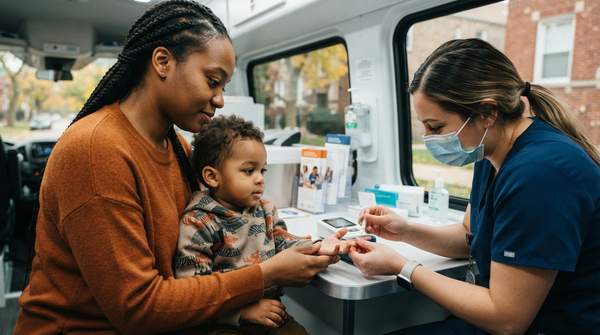
| 3. The finger stick | A licensed nurse-led team checks your child with a small finger stick. The test takes about three minutes. |
| 4. Same-day results | You get the result the same day, with counseling in English or Spanish. |
| 5. Follow-up if high | If the result is high, the team can take the follow-up sample right there — no separate trip needed — and connect families with prevention resources. |
What to bring: your insurance card if you have one. Families without insurance are still welcome. Additional language support beyond English and Spanish is available on request.
Step 1: Find a Testing Event and Prepare for Your Visit
To find upcoming locations and times, families can visit prism.org/lead or call (800) 325-1812, where they can also register in advance. The mobile team visits the places families already go — daycares, Head Start centers, libraries, WIC sites and churches — so look for the Prism Health van at those sites in the six pilot communities.
Registration is optional in the sense that walk-ins are welcome and no one is turned away, but registering ahead can help you plan. Before you leave home, grab your insurance card if you have one; if not, you can still be tested at no cost. No other preparation is described by the program.
Step 2: What to Expect On-Site – Check-in and the Quick Test
When you arrive, a team member checks you in, in English or Spanish. The testing itself is performed by a licensed nurse-led team using a small finger stick, and it takes about three minutes. Prism Health emphasizes the simplicity: "Five small steps. That's the whole thing."
Because events are held at familiar neighborhood locations rather than a clinic, families do not need to arrange a separate doctor's appointment or laboratory visit to complete the required screening.
Step 3: Receiving Same-Day Results and On-Site Follow-Up
Results are provided the same day as the test, along with counseling in English or Spanish. That means you leave the event knowing your child's result rather than waiting days for a call.
If a result is high, the team can take a follow-up sample on the spot, so you do not need to make a separate trip. The pilot also connects families with prevention resources, which is part of its broader aim of raising awareness and helping families act early. Health officials note that early testing is a key component of preventing lead poisoning in children.
Take Action: Get Your Child Tested for Lead
Parents of children aged 1-3 in the six pilot South Side neighborhoods should utilize the free mobile lead testing program to ensure early detection and access to resources. The service to look for is mobile blood lead testing for children in six South Side communities, beginning September 1, 2026 — a two-year pilot, so the window is defined.
Your next step is concrete: check prism.org/lead or call (800) 325-1812, find an upcoming event near you, and bring your child — with an insurance card if you have one — for a three-minute test with a same-day answer. This article covers how to access the testing service; it is not a comprehensive guide to lead prevention or home abatement, and it does not provide medical advice.
Sources
- New Pilot Program to Bring Childhood Lead Testing to Six South Side Neighborhoods — WTTW News
- New Mobile Pilot Brings Childhood Lead Testing to Chicago Neighborhoods
- Two-Year Pilot Will Bring Mobile Testing Directly to Families in Six Neighborhoods — Chicago Hispanic Newspaper, Lawndale News, Hispanic Bilingual Newspapers, Su Noticiero Bilingue
- Childhood Lead Testing Comes to Chicago's South Side — Prism Health
- Lead Poisoning Prevention: Blood Lead Testing for Kids — Prism Health