Chicago residents who want a hand in how their neighborhoods are policed have official, structured ways to do it. The city's Neighborhood Policing Initiative (NPI) assigns specific officers to build relationships in fixed geographic areas, and residents can engage them through beat meetings, problem-solving initiatives, neighborhood events, and community check-ins. The practical entry point is simple: identify your beat, find your local meeting, and use the right officer contact for the right concern.
Understanding Chicago's Neighborhood Policing Initiative (NPI)
The Chicago Neighborhood Policing Initiative is built on a philosophy that public safety is a shared responsibility of everyone who lives and works in a neighborhood. The initiative's own mission statement puts it plainly: residents and police are safer when they communicate effectively and work together, and by talking directly with residents, police can learn about the root causes of recurring public-safety concerns.
What distinguishes NPI from ordinary patrol policing is intentionality. The NPI Toolkit, developed in partnership with the Chicago Police Department, describes community engagement and participation as being "at the heart" of the model, which is designed to give community members a real voice in how their neighborhoods are policed. The Policing Project, which published the toolkit, notes that its lessons from Chicago are broadly applicable to other municipalities, but Chicago is where the model has been implemented and tested.
The initiative is also part of a larger city-wide effort to rebuild trust between communities and police, an effort that began after the 2014 fatal shooting of Laquan McDonald, a Black teenager, by Officer Jason Van Dyke, according to the NPI's mission page.
Understanding Community Policing Roles
Residents encountering NPI for the first time often ask the same question: who exactly am I supposed to talk to? The model creates several distinct community-facing roles, and knowing which officer does what helps you direct a concern to the right place. The table below categorizes them based on official descriptions from the NPI Toolkit and the initiative's own materials.
| Role | Primary Responsibility | How Residents Interact |
|---|---|---|
| Beat Officer | A uniformed officer permanently assigned to a specific beat who patrols the area, responds to calls for service, and engages in proactive community policing, building relationships with residents and businesses. | Attend beat meetings, raise local concerns directly, and collaborate on problem-solving initiatives. Their effectiveness depends on knowing the community and having established relationships. |
| District Coordination Officer (DCO) | Assigned to a District Coordinating Area (DCA); does not regularly respond to emergency calls. Instead, spends time working with community members, identifying resources, and seeking solutions to the area's public-safety concerns. | A dedicated point of contact for community input on policing strategies; engage through NPI activities and community-centered policing efforts. DCOs also coordinate with beat officers for continuity. |
| Community Ambassador | Intended, per the NPI Toolkit, to support the integration of police officers into neighborhood networks and provide an approachable way for residents to participate in public safety. | Described as a direct channel for residents to raise concerns and help keep policing strategies responsive to neighborhood priorities. |
The key distinction for residents: beat officers handle day-to-day patrol and enforcement on their beat, while DCOs are freed from regular emergency response so their time goes toward community work. That makes a DCO the natural contact for ongoing concerns and strategy input, and a beat officer the familiar face at local meetings and on the street.
Active Participation: Ways to Get Involved
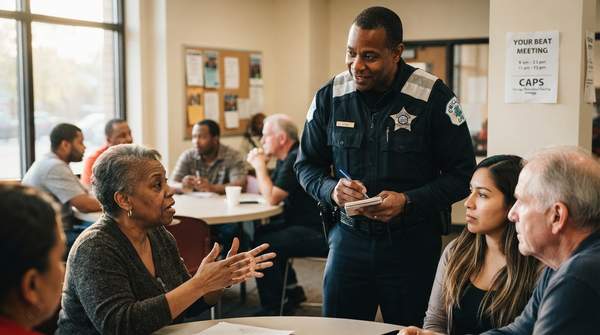
Understanding the structure is only useful if you act on it, and the CPD's community engagement framework lays out several concrete participation methods. The most established is attending beat meetings, where residents meet with officers to discuss public-safety plans and goals. The NPI Toolkit's own planning worksheets list "have and attend meetings (i.e. beat meetings, CAPs, etc.) w/residents and DCOs" as a core action, while flagging real barriers such as lack of consistency and scheduling conflicts.
Beyond meetings, the CPD framework describes problem-solving initiatives in which officers work with residents, businesses, and community partners to collaboratively address issues such as vandalism, drug activity, or troubled buildings. It also describes community check-ins, where officers proactively reach out to residents to assess feelings of safety and gather feedback, and neighborhood events like block parties, safety fairs, and educational workshops that connect officers and residents in relaxed settings.
Attendance itself is a solvable problem. A National Institute of Justice study of Chicago community policing documented officers visiting the homes of recent burglary victims to encourage beat meeting attendance, and one area where officers and residents together chose a more accessible meeting location saw attendance increase. Showing up, and bringing a neighbor, is part of how these programs work.
Finding Your Local Beat and Meeting Schedule
Participation starts with geography. Chicago is divided into police districts, districts into sectors (District Coordinating Areas), and sectors into beats, each with its own assigned officers. The Chicago Police Department publishes district and beat information on its website, and each district's community policing office maintains information about local beat meetings and scheduled events.
Because meeting times and locations are specific to each district and subject to change, there is no single city-wide schedule a resident can rely on indefinitely. The dependable approach is to look up your district and beat through CPD's online resources, then check your district's community meeting listings or contact the district's community policing staff for current details. District Councils, part of the city's public safety accountability structure, also hold regular public meetings where residents have a voice in decision-making processes, according to the NPI mission page.
Your Next Steps for Neighborhood Safety
The decision in front of you is to actively participate in Chicago's community policing by identifying your local beat, attending beat meetings, and engaging with Beat Officers, DCOs, and Community Ambassadors. The evidence from the NPI Toolkit, the CPD's engagement framework, and implementation research is consistent on one point: these programs depend on consistent engagement and collaboration between residents and police to work.
The measurable indicator to hold yourself to is regular attendance at local beat meetings and participation in problem-solving initiatives. That is the observable, repeatable behavior the model is built around, and it is the standard by which both residents and the department can tell whether neighborhood policing in your area is functioning as designed.