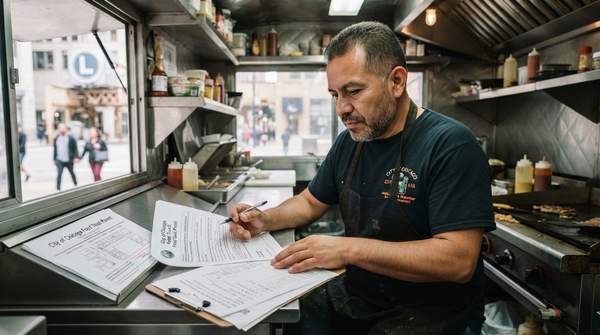
Launching a food truck in Chicago means navigating one of the more demanding municipal licensing systems in the country, and the single most consequential rule has nothing to do with paperwork. The city's 200-foot restriction, which bars mobile food vehicles from operating within 200 feet of a brick-and-mortar restaurant, eliminates most viable street spots in dense neighborhoods, according to industry analyses of the Chicago market. That constraint pushes many successful operators toward private property, catering, and events rather than traditional curbside vending. Before you pick a truck, you need to pick a model — and that choice starts with understanding what the city actually requires.
Navigating Chicago's Food Truck Landscape: An Overview
Chicago regulates mobile food through a layered system: a city Mobile Food License, health rules enforced through the commissary relationship, fire safety review, and state-level food safety certification. The city's own guidance is blunt about the boundaries. Food may not be prepared on or in any mobile food cart, and food prepared outside a licensed food establishment may only be prepared on a food truck holding a Mobile Preparer License.
The practical takeaway for a prospective owner is that Chicago's rules reward planning. Operators who build their model around private property, events, and catering can do very well in Chicago, as one 2026 permit guide put it, while those betting on high-traffic street corners often discover too late that the 200-foot rule has blocked their best locations. This guide covers the City of Chicago specifically — suburban Cook County and other Illinois municipalities run their own, often very different, programs — and it addresses licensing and operational rules, not vehicle purchasing, menu development, or business formation.
Essential Licenses and Permits for Your Chicago Food Truck
Chicago splits its core credential into two types, and the difference determines your entire operation. A Mobile Food Dispenser license covers trucks selling food that was pre-prepared in a licensed food establishment and sold in totally enclosed portions — no onboard cooking. A Mobile Food Preparer license is required for trucks that cook on the vehicle. The Preparer license costs more and carries heavier inspection burdens, but it opens menu options that Dispenser trucks cannot offer.
Here is the consolidated checklist of credentials a Chicago food truck operator needs to assemble:
- Chicago Mobile Food Vehicle (MFV) License — issued by the Department of Business Affairs and Consumer Protection (BACP); a two-year license, running roughly $700 for a Dispenser or $1,000 for a Preparer, per 2026 permit-guide estimates, with the current fee schedule to be verified with BACP.
- Shared Kitchen User License — mandatory for all Mobile Food licensees, because every truck and cart must be serviced at a licensed commissary kitchen where food preparation and storage may also occur.
- City of Chicago Business License — a general business license, estimated at around $250 per year in 2026 permit guides.
- Fire Safety Permit — required for trucks, particularly those with onboard cooking equipment.
- Illinois Food Service Sanitation Manager Certification — a manager certificate, distinct from a food-handler course; Chicago maintains its own certification process, and non-manager workers who meet the food-handler definition need applicable training unless exempt.
- GPS device installation — required equipment for mobile food vehicles under the city's rules.
Two hard prohibitions anchor the system. Food preparation or storage at home is not allowed, and food preparation on the street or sidewalk is not allowed — including on or in any mobile food cart. Every item you sell must trace back to a licensed brick-and-mortar establishment, which is why the Shared Kitchen User license is universal rather than optional.
Understanding Key Operational Rules and Restrictions
The 200-foot rule deserves its reputation as the defining constraint on Chicago street vending. Under the city code, food trucks cannot operate within 200 feet of a fixed restaurant, and enforcement is strict — most high-traffic corners in areas like the Loop and River North are effectively blocked. Operators who want to vend on the street must scout compliant locations in advance, often with measuring tools, and residential neighborhoods with fewer restaurants offer comparatively more viable spots.
The commissary requirement is the second structural constraint. Because home preparation is prohibited and street preparation is prohibited, your truck depends on a licensed commissary kitchen for storage, servicing, and (for Dispenser trucks) all food preparation. That relationship is a real cost and scheduling factor, not a formality.
Private property does not automatically escape these rules. The city code applies specified time, distance, consent, and zoning requirements to private-property operations, so a corporate-campus lunch contract still requires careful review of what the code allows at that site. And on taxes, Chicago's general sales-tax rate is not necessarily the whole picture for a food truck — restaurant, MPEA, and product-specific taxes can also apply, so operators should confirm their actual transactions with the relevant tax authorities.
Chicago Food Truck Business Model Comparison
The table below compares the main vending models available to a Chicago food truck, weighing each against the city's rules and the operational realities reported by industry guides. Read it as a decision matrix: match your truck concept and menu to the lane where the regulatory friction is lowest for you.
| Vending Model | Key Rule/Limitation | Business Reality/Opportunity | Best Truck Fit |
|---|---|---|---|
| Street vending (Loop, River North, high-traffic areas) | 200-foot restaurant rule severely limits viable spots; enforcement is strict | High foot traffic potential, but most prime corners are blocked; scout compliant spots in advance | Quick-service trucks (coffee, hot dogs, ice cream) that can pivot locations quickly |
| Neighborhood vending (Pilsen, Logan Square, Wicker Park) | Same 200-foot rule applies | Fewer restaurants means more viable spots; consistency builds a local following | Ethnic food trucks matching neighborhood demographics |
| Designated food truck stands / parks | Permit approval suffices if the park accepts new vendors | Limited slots; some parks have waitlists or exclusive agreements, so apply early; vendors often rotate weekly | Any truck type |
| Private property / corporate campuses | Property owner permission required; city code still applies time, distance, consent and zoning rules | Reported as the best revenue lane; predictable weekday scheduling | Lunch trucks (coffee, gourmet, healthy options) for predictable weekday revenue |
| Festivals and special events | Event-specific vendor applications required; preferred vendor lists common | Competitive applications; apply 3–6 months in advance | BBQ, tacos, Italian beef, dessert trucks with proven event track records |
| Catering and private events | MFV license covers it, though some venues require additional event permits | Reported as the most profitable lane for experienced operators; requires strong referrals and portfolio | BBQ trailers, upscale fusion, dessert trucks with strong presentation |
The pattern across the comparison is consistent: the models with the fewest location constraints — private property, catering, events — are also the ones industry guides report as the most profitable, while the highest-visibility street locations carry the heaviest regulatory burden. Note that suburban Cook County is excluded here as a distinct model: it is a different jurisdiction with different rules, and this guide does not cover it.
Strategic Decision: Choosing Your Chicago Food Truck Path
Prospective food truck owners in Chicago should prioritize business models centered around private events, catering, or designated food truck stands, as these often mitigate the severe limitations imposed by the 200-foot rule on traditional street vending. The street-vending lane is not closed, but it demands location scouting that accounts for restaurant density, and it favors nimble, quick-service concepts over elaborate menus.
Whatever lane you choose, the measurable indicator of a viable plan is concrete: a business plan that clearly outlines target vending locations and aligns with the correct Mobile Food Preparer or Dispenser license type, supported by a secured Shared Kitchen User license and Fire Safety Permit. Start the paperwork three to four months before opening day, as one 2026 permit guide advises — inspection slots, commissary letters, and certifications take longer than the application itself — and verify the current BACP fee schedule, which has been adjusted in recent years.
Sources
- Food Truck Permits in Chicago (2026): BACP MFV License + 200ft Rule — PitStop
- Mobile Food — Chicago
- Chicago Food Truck License 2026: $1,000 Permit Guide — StreetLegal
- How to Start a Food Truck in Illinois (2026) — StartBusinessByState.com