Chicago legally splits its growing spaces into two categories, and that distinction shapes how you can participate. If you want to grow your own vegetables, you rent a personal plot in a community garden. If you want to fight food insecurity, you volunteer at a communal or donational garden. If you want job training, you apply to a workforce-oriented urban farm. Here is how the three models compare, with named Chicago examples.
Official Distinctions: Community Gardens vs. Urban Farms
The City of Chicago draws the line in its Municipal Zoning Code. A community garden is a lot or portion of a lot used for cultivation by more than one person, limited to 25,000 square feet. An urban farm is a lot used for cultivation for sale or distribution, with no size limit, and the code permits accessory uses like composting and farm stands.
The city notes a practical catch: many growing sites call themselves "urban farms," but if they operate under 25,000 square feet in a residential area, they are legally considered community gardens under the municipal code. So the label on a sign may not match the label in the zoning code—size and purpose, not branding, determine the category.
Model 1: Personal Plot Community Gardens
This is the classic route for residents who want to grow food themselves. You claim a plot, choose your crops, and handle the watering, weeding, and harvesting on your own schedule.
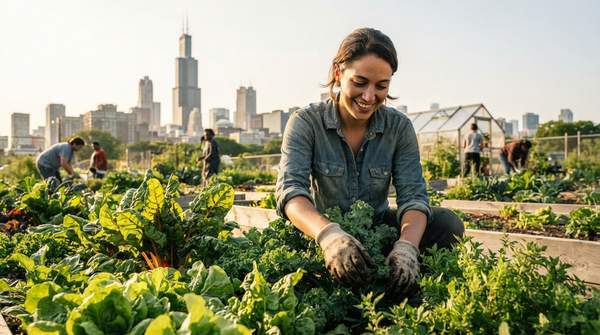
The Chicago Lights Urban Farm shows how it works. Its community garden offers 3-by-7-foot plots to individuals living or working within a five-block radius of the farm, bounded by LaSalle, Ohio, Halsted, and Division. Soil, water, and tools are provided, along with a community of fellow gardeners who can offer growing guidance. Gardeners are responsible for their own plots, and the farm also relies on volunteer support.
The trade-off: personal autonomy comes with personal responsibility. Your harvest is your own, but your weeds are too.
Model 2: Communal & Donational Gardens
If your goal is community contribution rather than personal production, communal gardens organize shared work around donated produce. The Chicago Community Gardeners Association describes several models: "Giving" or pantry gardens where all produce is donated, "Plant-a-Row" setups where gardeners grow an extra donation row in their individual plots, and gleaning, where gardeners place a sign indicating leftover produce can be harvested for donation. Peterson Garden Project's Grow2Give program is cited as an example.
Volunteer roles range widely—donation leaders, harvest teams, drivers or bikers who deliver produce, and community outreach. The Chicago Park District also runs volunteer opportunities across park gardens, including allotment plots, pantry gardening, and children's learning gardens, welcoming a range of experience levels.
Just Roots Chicago offers a concrete schedule: volunteers can join April through October on Wednesdays, Fridays, and Saturdays, 9am to 12pm, to learn regenerative growing practices while supporting food access on the South Side. The organization also runs a seasonal CSA program and Saturday farm stands from June through October.
Model 3: Workforce & Youth Development Urban Farms
The third model treats urban agriculture as a job pipeline. Windy City Harvest, run by the Chicago Botanic Garden, provides paid, hands-on training to more than 70 individuals each year, and the program reports that about 80 percent secure jobs in the food systems industry after completing it. Its VeggieRx program distributes free boxes of fresh produce to more than 3,300 individuals annually, and its flagship Farm on Ogden offers free nutrition and cooking classes along with therapeutic horticulture workshops reaching over 2,000 participants a year.
Here the participant's "produce" is skills and income, plus food that flows to the broader community rather than a personal bed. These larger operations also match the city's urban farm definition, since their produce is distributed at scale.
Chicago Urban Agriculture: A Comparative Framework
Use this table to match your goal to a model. The first two rows show the city's legal categories; the next rows classify the named programs by how you actually participate.
| Model | Primary goal for participant | Typical activities | Example programs |
|---|---|---|---|
| Community garden (official definition) | Shared cultivation on a small scale | Cultivation by more than one person, limited to 25,000 square feet | Defined in Chicago's Municipal Zoning Code |
| Urban farm (official definition) | Cultivation for sale or distribution | Larger-scale growing; accessory composting and farm stands allowed | Defined in Chicago's Municipal Zoning Code |
| Personal plot gardens | Grow your own food; learn alongside neighbors | Choosing crops, watering, weeding, harvesting your own 3'x7' plot | Chicago Lights Urban Farm community garden |
| Communal & donational gardens | Fight food insecurity; learn regenerative practices | Volunteer work days, donation harvests, gleaning, delivery, CSA and farm stands | Just Roots Chicago; Peterson Garden Project Grow2Give; Chicago Park District gardens |
| Workforce & youth development farms | Gain job skills and paid training in food systems | Paid hands-on training, youth programs, produce distribution to the community | Windy City Harvest; BUILD Chicago's youth urban agriculture programming |
The framework's logic is straightforward: each model answers a different question. Personal plots answer "what do I want to eat?" Communal gardens answer "who do I want to feed?" Workforce farms answer "what career do I want to build?" If a program distributes produce beyond its members—through VeggieRx boxes, farm stands, or pantry donations—it leans toward the communal or farm categories; if you keep the harvest, it is a plot model.
Deciding Your Urban Agriculture Journey in Chicago
Choose an urban agriculture program based on whether your primary goal is personal food cultivation, community contribution through volunteering, or structured skill development and job training. This article covers models, not a full directory—plot availability, volunteer schedules, and registration details change, so confirm current status with each organization before committing.
You will know the decision is made when you can identify a specific type of urban agriculture program—personal plot, communal, or workforce development—that matches your interests and understand the official distinctions, including the 25,000-square-foot threshold that separates a community garden from an urban farm in the zoning code. Your next step: check the residency radius for plot gardens like Chicago Lights, the April–October volunteer calendar at Just Roots Chicago, or the annual apprenticeship cycle at Windy City Harvest.
Sources
- Urban Agriculture — Chicago
- Urban Farm - Chicago Lights
- Share the Harvest - Chicago Community Gardeners Association — Chicago Community Gardeners Association - Learn Connect Grow
- Community Gardens — Chicago Park District
- Get Involved — Just Roots Chicago
- Windy City Harvest — Chicago Botanic Garden